

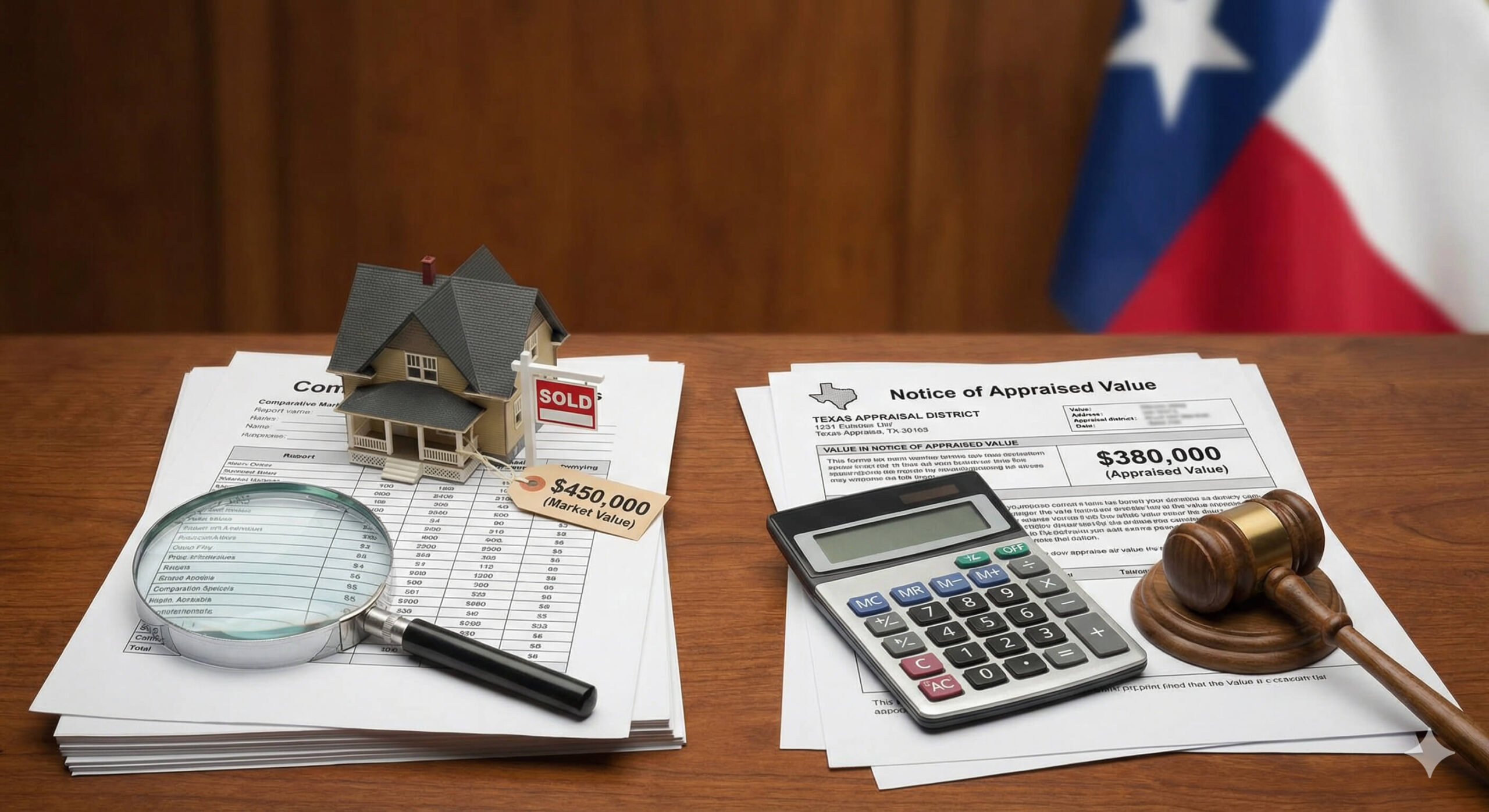
If you own property in Texas, you have probably heard two terms that sound similar but mean very different things: market value and appraised value. Understanding county appraisal vs. market value is one of the most important steps in deciding whether your property tax assessment should be challenged.
Market value is what your property would likely sell for under normal conditions. Appraised value is the value assigned by the county appraisal district for property tax purposes. Your taxes are based on the appraisal district's value, but market value evidence can help you protest and seek a lower taxable value.
| Term | What It Means | Why It Matters |
|---|---|---|
| Market Value | The likely sale price between a willing buyer and seller under normal conditions. | Market value evidence can help support a lower value during a property tax protest. |
| County Appraisal / Appraised Value | The value assigned by the county appraisal district for property tax purposes. | This value is used to help calculate the property tax bill unless successfully challenged. |
| Taxable Value | The value after exemptions, caps, or other adjustments may apply. | This is often the number that most directly affects the final tax bill. |
| County appraisal district's assessed value | $500,000 |
| Supportable market value (per comparable sales) | $440,000 |
| Difference | $60,000 |
| Combined local tax rate (representative) | 2.10% |
| Potential annual tax savings if protest succeeds | ~$1,260 |
Illustrative example only. Actual results depend on your specific property, county, evidence, and local tax rate — not guaranteed or typical for every case.
Your property tax bill is generally driven by the appraisal district's value, but market value evidence can be one of the strongest tools for lowering that number through a Texas property tax protest.
The phrase county appraisal vs. market value usually refers to the difference between what a county appraisal district assigns for tax purposes and what the property would likely sell for in the open market. These numbers can overlap, but they are not always the same.
If the county appraisal is higher than market value, or if your property is appraised unequally compared with similar properties, you may have grounds to file a protest. You can also review our guide on unequal appraisal in Texas property taxes to understand the equity side of a valuation challenge.
Market value is the amount a willing buyer would pay and a willing seller would accept under normal market conditions. It reflects what your property is actually worth in the current real estate market. The Texas Comptroller's own guidance on valuing property confirms this is the standard appraisal districts are required to estimate toward, even though mass appraisal methods don't always hit it precisely for every property.
Factors that can affect market value include:
Market value is especially important if you are buying, selling, or refinancing. In the property tax context, its real importance is that it can serve as evidence when the tax value appears too high.
Appraised value is the value assigned by your county appraisal district for property tax purposes. This is the number that helps calculate your property taxes before exemptions, caps, or other adjustments are applied.
Key things to know about appraised value:
That is why many Texas property owners end up paying taxes based on values that deserve a closer review.
When it comes to your tax bill, the appraised value is the number that directly matters because it is the value used for taxation. But when it comes to reducing that tax bill, market value often becomes the evidence that matters most.
In other words, your taxes are based on appraised value, but your protest is often supported by market value data. If you want to understand how that works in practice, read our guide on how to protest property taxes and win in Texas.
Even if the appraisal district says your value is supported, that does not mean the value is correct for protest purposes. Mass appraisal models can overlook condition problems, market changes, income issues, property record errors, and unequal appraisal concerns.
One of the most effective ways to protest an assessment is to show that your property's true market value is lower than the appraisal district's number.
You may be able to support your case with:
The stronger your market-value evidence, the better your chance of reducing the appraised value and, in turn, your property taxes.
If your county appraisal is higher than market value, these resources can help you connect valuation evidence to the protest and appeal process.
Lowering value through a protest is one path to reducing taxes, but it is not the only one. Some owners may also qualify for exemptions, caps, or other adjustments that affect taxable value.
Common items that can affect taxable value include:
These can reduce your taxable burden even if the appraised value itself does not change. For more detail, review Texas property tax exemptions, Texas property tax exemptions for over-65 owners, and the Texas homestead cap.
In some cases, the issue is not only market value. Your property may also be assessed higher than similar nearby properties. That can create a separate basis for protest under an unequal appraisal theory.
For example, your property may be appraised at $650,000 while similar properties in the same area are appraised closer to $590,000 or $600,000. Even if the appraisal district argues the market value is reasonable, the unequal treatment may still support a protest.
To learn more, see our article on what an unequal appraisal means in Texas property taxes.
For commercial property, market value may depend on income, expenses, vacancy, rent rolls, capitalization rates, tenant risk, property condition, location, and comparable sales. That makes commercial valuation more complex than a basic residential comparable-sales review.
If you own commercial, industrial, retail, office, multifamily, warehouse, or business personal property, review our Commercial Property Tax Protest in Texas guide and our Commercial Property Tax Services page for more property-type-specific guidance.
Even the best evidence will not help if you miss the filing deadline. Texas property tax protests are time-sensitive, and missing the deadline can mean losing your right to challenge the value for that year.
For deadline guidance, visit the Texas property tax deadlines calendar and the property tax appeal deadlines in Texas by county.
If the protest or Appraisal Review Board result does not fully resolve the valuation issue, some property owners may need to evaluate appeal options. Depending on the facts, value, evidence, and deadlines, those options may include arbitration or a property tax lawsuit.
Learn more from our pages on Appraisal Review Board hearings, property tax arbitration in Texas, and advantages of filing a property tax lawsuit in Texas.
If you want to reduce your Texas property taxes, focus on the number that drives the bill and the evidence that can change it.
PropertyTaxes.Law reviews properties every year and knows where appraisal districts often make mistakes. We help owners build stronger protests, identify useful evidence, and evaluate appeal options when the value remains too high.
These pages help connect market value, county appraisal value, protest deadlines, appeal options, and potential lawsuit strategy.
Learn how to challenge an appraisal district value with market, equity, and property-specific evidence.
Review practical protest steps, evidence types, and strategy for lowering an assessment.
Understand when similar properties are appraised differently and how that may support a protest.
Learn when a protest may be worth it and how it can help reduce a tax bill.
Understand next steps if the protest result does not fully resolve the valuation dispute.
Review attorney-supported protest and appeal help for Houston-area property owners.
Local county pages can help connect appraisal district values, protest deadlines, and evidence strategy.
Review Harris County appraisal district and protest guidance.
Local guidance for Fort Bend County appraisal district notices and protests.
Review Hays County appraisal notices, deadlines, and protest options.
Local guidance for Nueces County property tax protest issues.
Review protest help and appraisal district guidance for McLennan County.
Local protest guidance for Comal County property owners.
Market value is what your property would likely sell for under normal conditions. Appraised value is the value assigned by the county appraisal district for property tax purposes.
Texas property taxes are generally based on the appraisal district's value, subject to exemptions, caps, and other adjustments. Market value evidence can help challenge that number in a protest.
Yes. If the county appraisal appears higher than market value, you may be able to file a protest and present evidence such as comparable sales, repair estimates, market data, or an independent appraisal.
Helpful evidence may include comparable sales, condition photos, repair estimates, market reports, appraisals, income and expense data, vacancy records, or rent rolls for commercial property.
Yes. Market value focuses on what the property is worth. Unequal appraisal focuses on whether your property is appraised higher than similar properties.
Exemptions and caps generally affect taxable value. They may reduce the amount of value that is ultimately taxed, even if the appraised value itself does not change.
Yes. "Tax appraisal" is another common way property owners refer to the county appraisal district's assessed value used to calculate the property tax bill. It means the same thing as "appraised value" in this context — as opposed to market value, which is what the property would likely sell for.
Let PropertyTaxes.Law review your assessment, identify where the appraisal district may have overreached, and help you pursue a stronger protest or appeal strategy.
Contact UsBrandon and his team have proven they can perform with any product type we give them,
from industrial and office property to single and multi-family residential.
At a critical time when a property was in lease-up, we were faced with an unreasonable and unjustified assessment.
Brandon’s tenacity and responsiveness resulted in a fair assessment and the largest value change I've seen in my career.
Outstanding!! These guys are pros - they are great at what they do and great to work with.