

If a Texas property tax protest is not resolved informally, the dispute may proceed to a formal Appraisal Review Board hearing. Knowing the evidence rules, hearing sequence, burden of proof, appearance options, and post-hearing deadlines can make the process much easier to navigate.
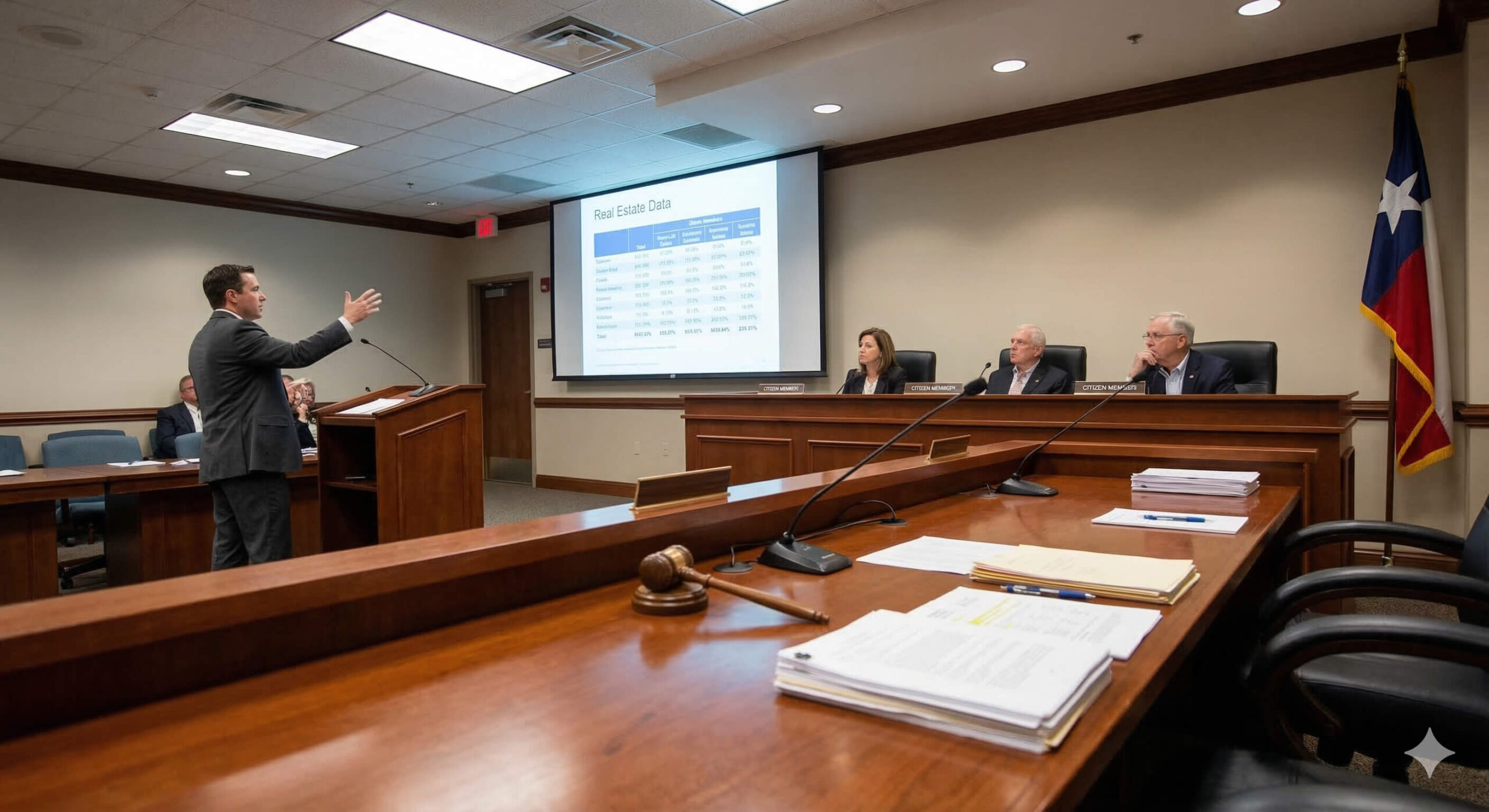
At an ARB hearing, the property owner or authorized representative and the appraisal district each have an opportunity to present evidence, examine witnesses, and argue the protest. The property owner may elect whether to present first or after the appraisal district. Testimony is given under oath. After considering the evidence presented at the hearing, the ARB issues a written order determining the protest. For value and unequal-appraisal protests, Texas law generally places the burden of establishing value on the appraisal district, subject to important exceptions.
An Appraisal Review Board (ARB) is a locally appointed group of citizens authorized to resolve disputes between property owners and appraisal districts. ARBs hear taxpayer protests and taxing-unit challenges. Their decisions are binding for the tax year at issue unless the property owner properly pursues an available appeal.
ARB hearings typically occur from May through July, although larger appraisal districts may continue hearings beyond July. The ARB is separate from the appraisal district staff whose appraisal is being protested.
Terminology: the ARB hearing is the formal protest stage. If the owner later challenges the ARB's written order through district court, regular binding arbitration, or another eligible route, that later stage is generally an appeal.
| Before the Hearing | Texas Rule to Know |
|---|---|
| Hearing notice | The ARB generally must send notice of the hearing date, time, place, subject matter, and estimated-tax information at least 15 days before the hearing. |
| Taxpayer materials | At least 14 days before the hearing, the appraisal district must provide the Taxpayer Assistance Pamphlet, adopted ARB hearing procedures, and information explaining the owner's right to request the evidence the district will use. |
| Appraisal district evidence | If requested, evidence the appraisal district intends to use at the protest hearing must be made available to the owner or agent at least 14 days before the hearing and is provided at no charge. |
| Remote appearance | A property owner may appear in person, by telephone conference call, by videoconference, or through a written affidavit, subject to the statutory notice and evidence requirements. |
| Local procedures | Each ARB adopts hearing procedures that must incorporate the Comptroller's model procedures. Review the local version before the hearing because it may address evidence copies, electronic presentation, check-in, and scheduling details. |
This is one of the most important preparation steps. If you request the information the appraisal district plans to use, Texas law protects you against undisclosed requested evidence. Information requested under Tax Code §41.461 that is not delivered at least 14 days before the scheduled or postponed hearing generally may not be used or offered as evidence at the hearing.
Do not rely only on the district's packet. Build your own evidence around the actual protest grounds. For a structured approach, see our Property Tax Protest Evidence Packet guide.
Be on time and confirm which property account and protest grounds are being heard. The ARB should follow its adopted hearing procedures.
Texas law requires testimony at the ARB hearing to be given under oath. Documentary evidence may also be offered subject to the hearing rules.
The property owner or authorized representative may elect whether to present evidence before or after the appraisal district representative presents its evidence.
The property owner and appraisal district may present evidence, examine witnesses, and state an opinion of value when value is at issue. Keep the presentation tied to the protest grounds rather than the size of the tax bill alone.
The ARB must decide the protest based on the evidence and argument properly before it. ARB procedures also address a party's right to examine or cross-examine witnesses and the prohibition on considering information that was not provided at the hearing.
The ARB determines the protest by written order. If the protest concerns appraised value, the order identifies the value shown in the appraisal records and the value finally determined by the ARB.
On request, the appraisal district's hearing evidence must be made available at least 14 days before the hearing and provided without charge.
Requested information not delivered at least 14 days before the hearing generally cannot be used or offered as evidence at that hearing.
For a value protest, the ARB generally may not set the appraised value above the value shown in the appraisal records submitted by the chief appraiser, unless the owner requests and agrees to it. Statutory exceptions apply to certain exemption and special-appraisal disputes.
In most market-value and unequal-appraisal protests, the appraisal district must establish the value under the evidentiary standard required by Tax Code §41.43.
Texas law provides telephone and videoconference hearing options when the owner follows the required notice procedures. An owner may also submit evidence or argument by affidavit.
ARB rules must provide for hearings on Saturday or after 5 p.m. on a weekday. The first weekday-evening hearing may not begin after 7 p.m., and protests may not be scheduled on Sunday.
The older version of this article said that “the burden of proof still rests on you.” That is too broad for Texas value protests.
Under Tax Code §41.43, in a protest of appraised value or unequal appraisal, the appraisal district generally has the burden of establishing the property's value by a preponderance of the evidence. If the district fails to meet that standard, the protest is determined in favor of the property owner.
Texas law can impose a clear-and-convincing evidence burden on the appraisal district in certain situations, including specified cases involving a qualifying recent certified appraisal or a value that was reduced in the preceding year when the statutory conditions are satisfied.
Important exception: if a property owner fails to provide a rendition statement, required property report, or certain information requested under Tax Code §22.07(c), §41.43 can shift the burden to the property owner. The exact burden therefore depends on the protest and the owner's compliance with applicable reporting requirements.
Even when the appraisal district bears the formal burden, a property owner should still present strong, organized evidence. A statutory burden of proof is not a substitute for preparing the facts that support the requested result.
The best evidence depends on whether the protest concerns market value, unequal appraisal, exemptions, property characteristics, or another appraisal issue.
| Evidence | What It Can Help Establish |
|---|---|
| Comparable sales | Whether the appraisal district's market-value conclusion is supported by relevant sales. |
| Comparable appraisal records | Whether the property is being appraised equally and uniformly compared with appropriate similar properties. |
| Photos and repair estimates | Condition, deferred maintenance, damage, or features not reflected in the appraisal model. |
| Property record corrections | Errors involving square footage, age, land size, classification, improvements, construction, or use. |
| Leases, rent rolls, income and expenses | Actual and market income-related facts for commercial, multifamily, and other income-producing property. |
| Independent appraisal | A supported alternative opinion of value when relevant to the property and tax year. |
| Engineering reports, surveys, blueprints or other technical records | Property-specific physical, access, construction, site, or condition issues. |
For equal-and-uniform issues, see our Unequal Appraisal in Texas guide.
Yes. Texas law allows an owner to appear by telephone conference call or videoconference when the required notice is provided. Under current §41.45, an unrepresented owner generally must notify the ARB no later than the fifth day before the hearing, while an owner represented by an agent generally has an earlier 10-day notice requirement.
A property owner may also offer evidence or argument by affidavit without personally appearing. If appearing by telephone or videoconference, the statute requires the owner's evidence to be offered by affidavit and submitted before the hearing begins. Review the local ARB procedures carefully before choosing a remote format.
In counties where special ARB panels are required and available, certain high-value commercial, utility, industrial/manufacturing, and multifamily properties may qualify. For 2026, the Texas Comptroller lists a minimum appraised-value threshold of $62,883,169.
Special-panel members must meet specified professional or experience qualifications. Owners of qualifying high-value property should review the hearing notice and local procedures to determine whether special-panel rights apply.
For a protest of appraised value, Tax Code §41.47 generally prevents the ARB from determining a value higher than the value shown in the appraisal records submitted by the chief appraiser, unless the property owner requests and agrees to the higher amount. The rule contains exceptions for certain exemption and special-appraisal disputes.
So the older article's basic point was directionally correct, but “you have nothing to lose by protesting” was too broad. A protest still involves deadlines, evidence, possible costs of representation, and strategic considerations even though the ARB generally cannot retaliate by simply raising the protested appraised value above the submitted appraisal-record value.
The ARB issues a written order determining the protest. Its determination is binding for the tax year unless an available appeal is properly pursued.
If the owner remains dissatisfied, post-ARB options may include district court, regular binding arbitration, or the State Office of Administrative Hearings when the property and dispute meet the statutory requirements.
For the next stage, review our Texas Property Tax Appeal, Property Tax Arbitration, and Texas Property Tax Lawsuit guides.
Procedural-rights remedy: Texas also provides limited binding arbitration for certain ARB procedural violations, including failures involving hearing procedures, evidence delivery, scheduling, the opportunity to present or examine evidence, and other listed requirements. Strict notice and filing deadlines apply.
An ARB hearing is the formal administrative hearing for a property tax protest. The property owner or representative and the appraisal district present evidence and argument to the Appraisal Review Board, which then issues an order deciding the protest.
Review the local hearing procedures, request the appraisal district's evidence early, identify the exact protest grounds, organize your own supporting evidence, prepare a concise requested value or other remedy, and confirm the hearing format and deadline requirements.
The ARB generally must send the hearing notice at least 15 days before the hearing. At least 14 days before the hearing, the appraisal district must also provide required taxpayer materials and information about the right to request its hearing evidence.
Yes. If requested, the appraisal district must make the evidence it intends to use available at least 14 days before the hearing and provide it without charge. Requested information not timely delivered generally may not be used at the hearing.
For most appraised-value and unequal-appraisal protests, the appraisal district has the burden of establishing value by a preponderance of the evidence. Different standards or a shift in burden can apply in specified circumstances under Tax Code §41.43.
Generally, the ARB may not set the protested appraised value above the value shown in the appraisal records submitted by the chief appraiser unless the owner requests and agrees to it. Certain exemption and special-appraisal disputes are exceptions.
Yes, Texas law provides telephone and videoconference options when the owner follows the applicable notice requirements. Evidence requirements differ for remote appearances, so review §41.45 and the local ARB procedures before the hearing.
The owner may have post-ARB appeal options including district court, regular binding arbitration, or SOAH, depending on the property and issue. Separate deadlines and eligibility requirements apply.
PropertyTaxes.Law can help review the appraisal district's evidence, identify protest grounds, organize valuation and unequal-appraisal evidence, and represent property owners through the ARB process.
Review Your ARB Hearing StrategyThis article provides general educational information and is not legal, tax, or appraisal advice. Hearing procedures, evidence requirements, burden-of-proof rules, remote-hearing deadlines, special-panel eligibility, and appeal rights can depend on the property, protest ground, appraisal district, and current law. Confirm current procedures with the applicable appraisal district and official Texas sources, and consult qualified counsel for legal advice.
Brandon and his team have proven they can perform with any product type we give them,
from industrial and office property to single and multi-family residential.
At a critical time when a property was in lease-up, we were faced with an unreasonable and unjustified assessment.
Brandon’s tenacity and responsiveness resulted in a fair assessment and the largest value change I've seen in my career.
Outstanding!! These guys are pros - they are great at what they do and great to work with.