

If your Appraisal Review Board decision still leaves you overpaying, filing suit in district court is one of two paths forward. Here's what it actually costs, how long it takes, and when it's the better option over arbitration.
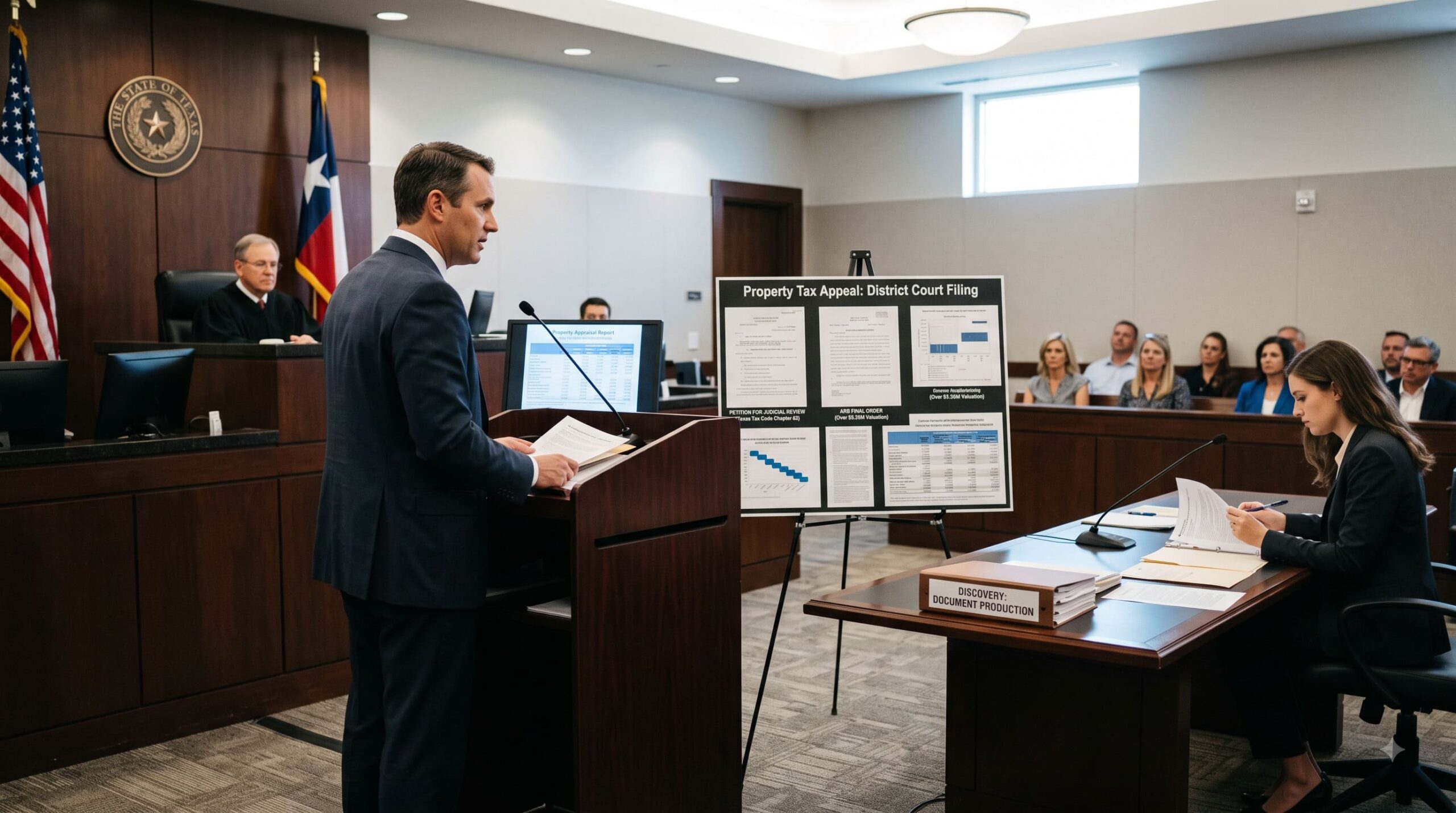
When an Appraisal Review Board decision doesn't resolve your dispute fairly, Texas law gives you the right to appeal further under Tax Code Chapter 42 — either through binding arbitration or by filing a lawsuit in district court. A lawsuit is often the right move for properties that don't qualify for arbitration, or where the case genuinely needs the full discovery process a court provides.
Filing a property tax lawsuit in Texas typically costs between $368 and $475 in court fees (petition filing, citation, and service costs), depending on the county. The full process generally takes 9 to 15 months to resolve. If you're moving forward with PropertyTaxes.Law, the suit is typically filed within 2 to 5 days of a signed engagement agreement.
Important: Unlike arbitration, a lawsuit involves full discovery — both sides can request documents and take depositions. This makes litigation more time-intensive, but it's also the only appeal option available for non-homestead properties valued above $5.36 million in 2026, since those properties don't qualify for arbitration.
A property tax lawsuit is filed under Tax Code Chapter 42 after the Appraisal Review Board issues its final order. The suit is filed in the district court of the county where the property is located, and it challenges the ARB's determination of value directly.
Texas Tax Code §42.08 requires property owners to pay a portion of their property taxes — generally the amount not in dispute — while a lawsuit is pending, in order to avoid delinquency penalties and interest. This is often referred to as the "§42.08 payment requirement" or "suit pending" rule.
In practice, this means filing a lawsuit doesn't pause your obligation to pay property taxes on time. Failing to make the required prepayment while your suit is pending can result in the case being dismissed, so this is a deadline that should never be missed once litigation begins.
| Factor | Property Tax Lawsuit | Binding Arbitration |
|---|---|---|
| Discovery | Full discovery available — document requests and depositions | None — no depositions, no compelled document production |
| Timeline | 9–15 months to resolve | ~45 days negotiation, then up to 120 days to schedule a hearing |
| Eligibility | No value cap — available to any property | Homestead: no cap. Non-homestead: capped at $5.36M (2026) |
| Cost structure | Filing/citation/service fees, typically $368–$475 depending on county | Deposit ($450–$1,550 depending on value/homestead status), refunded minus $50 if successful |
| Tax payment obligation | Must continue paying undisputed portion under Tax Code §42.08 while the suit is pending | No special prepayment rule tied specifically to arbitration |
For a full breakdown of arbitration deposits, timelines, and eligibility, see our property tax arbitration in Texas guide.
Non-homestead properties valued above $5.36 million (2026) aren't eligible for arbitration at all — litigation is the only appeal path available.
If your case depends on documents or testimony the appraisal district hasn't produced voluntarily, only a lawsuit gives you the legal tools to compel it.
Commercial, industrial, and high-value properties with disputed income, expense, or valuation methodology issues often benefit from the fuller evidentiary process litigation provides.
PropertyTaxes.Law can review your ARB decision, confirm your eligibility for each option, and handle the process from filing through resolution.
Get a Free Case ReviewBrandon and his team have proven they can perform with any product type we give them,
from industrial and office property to single and multi-family residential.
At a critical time when a property was in lease-up, we were faced with an unreasonable and unjustified assessment.
Brandon’s tenacity and responsiveness resulted in a fair assessment and the largest value change I've seen in my career.
Outstanding!! These guys are pros - they are great at what they do and great to work with.