How to Prepare a Texas Property Tax Protest Evidence Packet
A step-by-step guide to building the evidence package that supports your Texas property tax protest — from a licensed Texas property tax attorney and consultant.
The difference between a successful Texas property tax protest and an unsuccessful one often comes down to one thing: the strength of your evidence. Filing the protest form preserves your right to challenge. What you bring to the informal review or Appraisal Review Board (ARB) hearing — your evidence packet — is what actually wins the reduction.
This guide walks through exactly what to include, how to organize it, and what makes the strongest case for each type of protest ground. It also includes a free, copy-paste evidence packet checklist you can use to prepare before your hearing.
Texas Note: In Texas, you file the formal protest using a written notice or your appraisal district's online portal (such as HCAD's iFile). The evidence packet is what you prepare and present at the informal review or ARB hearing to support a lower value. Preparing a thorough, well-organized evidence packet gives you the best chance of resolving the case at the informal stage — before an ARB hearing is even needed.
What Is a Property Tax Protest Evidence Packet?
A property tax protest evidence packet is the collection of documents, data, and exhibits you prepare to support your case that the appraisal district has overvalued your property. It is not a form — it is your argument, organized and presented in a format the appraiser or ARB panel can review efficiently.
The packet typically includes a cover sheet identifying the property and your requested value, followed by labeled exhibits: comparable sales, comparable assessed values from the district's own records, condition documentation, and any other evidence that supports a lower valuation. In Texas, most protests involve a combination of market value arguments (the property is worth less than the assessed amount) and unequal appraisal arguments (similar properties are assessed lower).
How it fits into the protest process
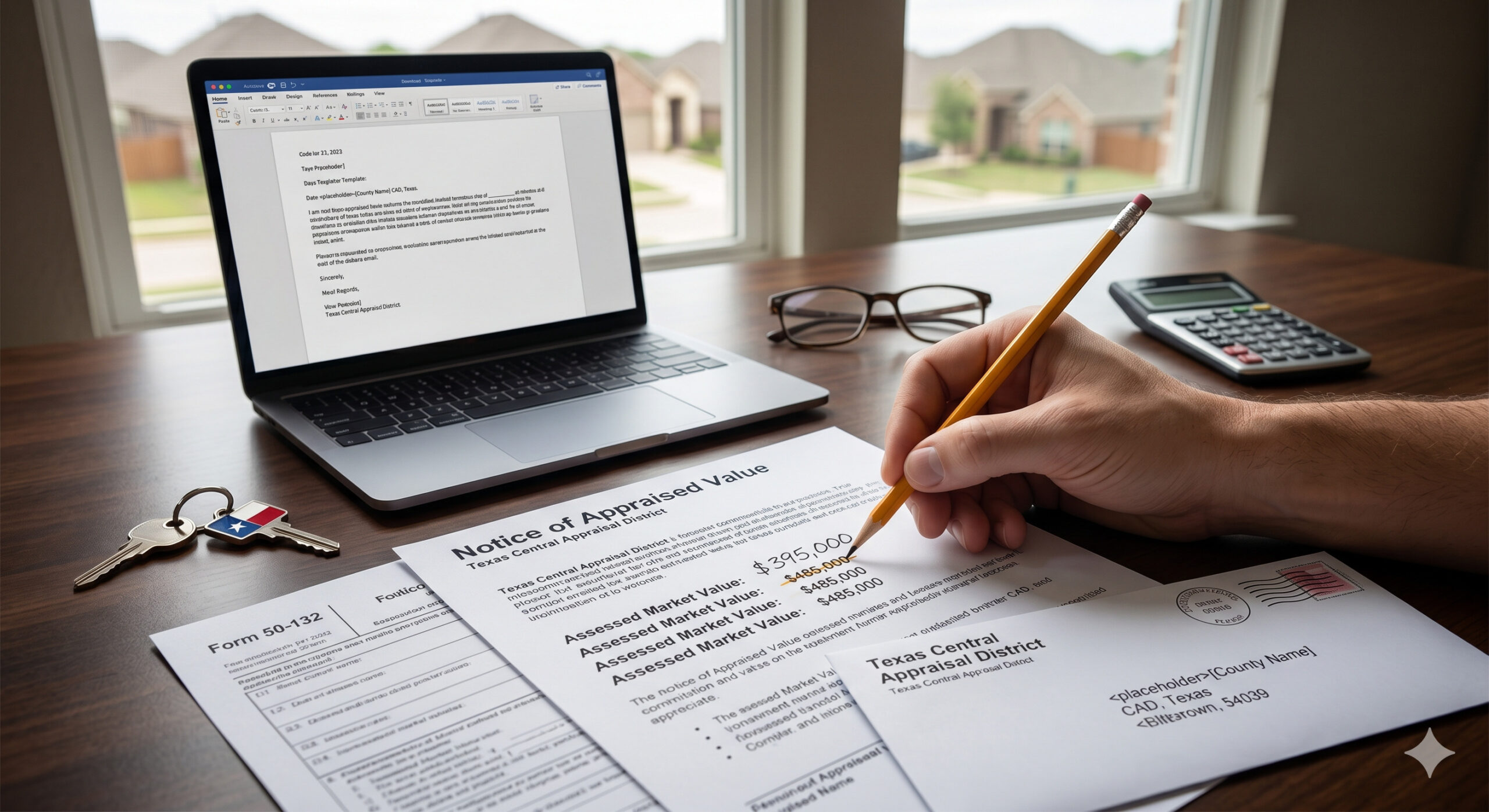
Filing the protest notice (Form 50-132 or the online equivalent) preserves your right to be heard. It is the procedural step. The evidence packet is the substantive step — it is what you use to actually make your case at the informal review and, if needed, the ARB hearing. One opens the door; the other wins the argument.
HCAD note: If you file online through HCAD's iFile system, you have 5 calendar days after filing to upload your evidence electronically. HCAD's iSettle system will then review your evidence and may send a settlement offer. Preparing your evidence packet before filing — not after — gives you the best position at every stage. See our Harris County property tax protest guide for HCAD-specific details.
When Should You Prepare an Evidence Packet?
You should begin preparing your evidence packet as soon as you receive your Notice of Appraised Value and decide to protest. The earlier you start, the stronger the packet. Here is when an evidence packet is needed:
Before your informal review — Submitting organized evidence ahead of the meeting signals preparation and gives the appraiser time to review your position before you arrive. Many protests are resolved at this stage.
At your ARB hearing — Your evidence packet is submitted as your formal presentation to the panel. A complete, organized packet is far more persuasive than verbal arguments alone.
For written protest rulings — If you cannot attend in person, you may submit your evidence for a written ruling by the ARB in some cases.
When pursuing arbitration or court — If the protest does not resolve the issue, your evidence packet becomes the foundation for the next stage. A well-documented packet from the initial protest strengthens every subsequent step.
Key deadline: In most Texas counties, your protest must be filed by May 15, or within 30 days after your Notice of Appraised Value is delivered — whichever is later. Your evidence packet should be prepared before your informal review or ARB hearing date, which typically follows 4–8 weeks after filing. See our full Texas property tax deadlines by county guide.
What to Include in a Texas Property Tax Protest Evidence Packet
A strong evidence packet contains seven core components. Missing any of them weakens your position — especially at the ARB stage where the district presents its own evidence simultaneously.
1
Cover sheet — property information and protest summary
Include the property address, appraisal account number, tax year, the district's current assessed value, your requested value, and the grounds for protest (market value, unequal appraisal, or incorrect data). This one-page summary tells the appraiser or panel everything they need before reviewing your exhibits.
2
Exhibit A — comparable sales
Recent arm's-length sales of similar properties in your area. Aim for three to five comparable sales within 12 months, similar square footage and condition, and within a one-mile radius where possible. Include the address, sale date, sale price, and square footage for each comparable. Pull from HAR.com, Zillow, Realtor.com, or the appraisal district's public records.
3
Exhibit B — unequal appraisal comparables
Properties from the appraisal district's own records that are assessed at a lower dollar-per-square-foot value than your property. This is often the most powerful argument in Texas because the data comes directly from the district's records — it is difficult to dispute. Access comparable assessed values through your county CAD's public portal. Texas is a non-disclosure state, so this argument does not require home sale data.
4
Exhibit C — condition documentation
Photos, repair estimates, inspection reports, or contractor bids that document condition issues not reflected in the district's assessment — roof damage, foundation issues, deferred maintenance, outdated systems, or structural problems. Each piece of condition documentation should be linked directly to a dollar impact on value wherever possible.
5
Exhibit D — property data corrections (if applicable)
If the appraisal district's records contain factual errors — wrong square footage, incorrect lot size, wrong year built, incorrect property classification, or other data errors — document the correct information with supporting documentation such as a survey, building permit, deed, or appraisal. Factual errors are among the easiest protests to win if the error is documented.
6
Exhibit E — independent appraisal (if available)
A formal appraisal from a licensed Texas appraiser is the strongest single piece of evidence in a market value protest. It is particularly effective for high-value residential property, commercial property, or when comparable sales evidence is thin. It is not required for every protest — many cases are won with comparables alone — but it carries significant weight if available.
7
Exhibit F — income and expense data (commercial property)
For income-producing property — multifamily, office, retail, industrial — income-based evidence is often more persuasive than comparable sales. Include actual rent rolls, vacancy rates, operating expenses, and a market cap rate analysis showing a lower income-based value than the district's income-approach estimate. Include any lease terms, rent concessions, or below-market tenancy that affects the property's net operating income.
How to Build Your Evidence Packet: Step by Step
Step 1 — Request the appraisal district's evidence first
Before you finalize your own packet, request a copy of the appraisal district's evidence. In Texas, you have the right to receive the district's evidence at least 14 days before your ARB hearing. This evidence typically includes the property data card, the mass appraisal model used to value your property, and sometimes comparable sales the district used. Reviewing it lets you identify exactly where the district's valuation is weakest — and tailor your evidence directly to those weaknesses.
Step 2 — Pull and review your property data card
Access the appraisal district's public portal and download your property data card. Review every field: square footage, year built, quality grade, condition rating, lot size, and improvement details. Errors in any of these fields can materially inflate the assessed value. If you find errors, document the correct information with supporting evidence and build Exhibit D around those corrections.
Step 3 — Build your comparable sales (Exhibit A)
Select three to five recent sales of comparable properties. The tighter the comparability — similar size, condition, location, and sale timing — the more persuasive the evidence. Adjust mentally for obvious differences (a comparable with a pool may sell for more; a distressed sale may be below market). If your area has limited comparable sales, expand the search radius or time window slightly and explain the limitation in your cover sheet.
Why unequal appraisal is often stronger in Texas: Because Texas is a non-disclosure state, sale prices are not publicly recorded and appraisal districts have limited comparable sales data. This often makes the unequal appraisal argument — which uses the district's own assessed values as evidence — more accessible and harder to dispute. Build Exhibit B alongside Exhibit A whenever possible.
Step 4 — Pull unequal appraisal comparables (Exhibit B)
Access your county's appraisal district public portal and search for properties similar to yours — same general location, similar size, similar property type. Download or note the assessed value and square footage of each. Calculate the assessed value per square foot for each comparable and compare it to your property's assessed value per square foot. If comparable properties are assessed at a meaningfully lower rate, you have an unequal appraisal argument. Present this as a simple side-by-side table in your packet.
Step 5 — Document condition issues with photos and estimates (Exhibit C)
Walk through the property with a smartphone or camera and photograph every condition issue — damaged roof, aging HVAC, foundation cracks, water intrusion, deferred maintenance, outdated electrical. For significant items, obtain written repair estimates from licensed contractors. The dollar amount of needed repairs, documented in writing, directly supports a lower assessed value. Organize photos with captions, not as a random image dump.
Step 6 — Organize, label, and tab your exhibits
Assemble your packet with a cover sheet first, followed by each exhibit in order (A, B, C, D, E, F). Label each exhibit clearly on the first page. Use divider tabs or clear section headers if submitting a physical packet. If submitting electronically (such as through HCAD's iFile), organize exhibits as clearly labeled PDF files or sections within a single PDF. An organized, easy-to-read packet signals professionalism and makes it easier for the appraiser or panel to follow your argument.
Use the checklist below as the cover sheet and organization guide for your evidence packet. Copy and fill in every highlighted field before your informal review or ARB hearing.
Free Copy-Paste Checklist
Texas Property Tax Protest — Evidence Packet
Use as your cover sheet and exhibit checklist for informal review and ARB hearing submissions.
Property Information
Property address: [Full Property Address]
Appraisal account no.: [Account Number — from your notice]
Appraisal district: [HCAD / TCAD / DCAD / BCAD / other]
Tax year: [Year]
Owner name: [Your Full Name]
Contact: [Phone] | [Email]
Protest Summary
District's current assessed value: $[Current Value]
My requested value: $[Requested Value]
Estimated tax savings at requested value: $[Estimated Savings]
Grounds for Protest
☐ Over-appraisal (market value): The assessed value exceeds what this property would sell for under normal market conditions as of January 1, [Year].
☐ Unequal appraisal: Comparable properties in the appraisal district's own records are assessed at a lower value per square foot than my property.
☐ Incorrect property data: The appraisal record contains errors in [square footage / lot size / year built / condition / quality grade / other] that inflate the assessed value.
Exhibit Index
☐ Exhibit A — Comparable Sales List [3–5] comparable sales below:
[Address] — Sold [Date] — $[Price] — [Sq Ft] sq ft — Source: [MLS/Zillow/CAD]
[Address] — Sold [Date] — $[Price] — [Sq Ft] sq ft — Source: [MLS/Zillow/CAD]
[Address] — Sold [Date] — $[Price] — [Sq Ft] sq ft — Source: [MLS/Zillow/CAD]
[Address] — Sold [Date] — $[Price] — [Sq Ft] sq ft — (optional)
[Address] — Sold [Date] — $[Price] — [Sq Ft] sq ft — (optional)
☐ Exhibit B — Unequal Appraisal Comparables List [2–5] comparable properties from district records, assessed lower per sq ft:
[Address] — Assessed $[Value] — [Sq Ft] sq ft — $[Value/SqFt]/sq ft
[Address] — Assessed $[Value] — [Sq Ft] sq ft — $[Value/SqFt]/sq ft
[Address] — Assessed $[Value] — [Sq Ft] sq ft — $[Value/SqFt]/sq ft
My property: $[Assessed Value] ÷ [Sq Ft] sq ft = $[Value/SqFt]/sq ft
☐ Exhibit C — Condition Documentation Photos, repair estimates, or inspection reports for: [List issues: roof / foundation / HVAC / other]
☐ Exhibit D — Property Data Corrections (if applicable) Error: [describe error] — Correct value: [correct figure] — Source: [survey/permit/deed/other]
☐ Exhibit F — Income & Expense Data (commercial/income property only) Rent roll, vacancy, NOI, market cap rate, income-based value: $[Value]
Pre-Hearing Checklist
☐ Requested the appraisal district's evidence at least 14 days before my hearing
☐ Reviewed the district's evidence for weaknesses in their comparable selection or data
☐ Confirmed my ARB hearing date, time, and location (or video link)
☐ Brought or uploaded copies of all exhibits — keep one set for yourself
☐ Prepared a concise verbal summary of my argument (3–5 minutes)
☐ Know my requested value and the dollar of supporting evidence behind it
Before your hearing: Fill in every highlighted field. Label each exhibit clearly. Bring at least two copies of your complete packet to any in-person hearing — one for the panel, one for yourself. If submitting electronically (HCAD iFile, TCAD portal, etc.), organize exhibits as clearly labeled PDF files or sections. If you are working with a property tax attorney or authorized agent, include their name, contact information, and the completed Form 50-162 (Appointment of Agent).
Types of Evidence That Strengthen a Protest
The outcome of your protest depends almost entirely on the quality and organization of your evidence. Here is a breakdown of the most effective evidence types, and when each one is most useful:
Comparable Sales (Exhibit A)
Recent sales of similar nearby properties. Best for market value arguments. Aim for sales within 12 months, similar size and condition, within 1–2 miles. Source from HAR.com, Zillow, or CAD public records.
Unequal Appraisal Comps (Exhibit B)
Properties from the district's own records assessed at a lower value per square foot. Often the strongest Texas argument — data comes directly from the district and is hard to dispute. Access through your county's CAD portal.
Condition Photos (Exhibit C)
Photos documenting deferred maintenance, roof damage, foundation issues, outdated systems, or poor condition relative to comparables. Organize with captions noting the issue and location on the property.
Repair Estimates (Exhibit C)
Written contractor or inspection company estimates for necessary repairs. A documented $35,000 roof replacement directly supports a lower assessed value. Obtain estimates from licensed contractors for credibility.
Independent Appraisal (Exhibit E)
A formal appraisal from a licensed Texas appraiser is the most authoritative single piece of evidence for market value protests. Particularly effective for high-value residential and commercial properties.
Income Data (Exhibit F — Commercial)
For income-producing property: rent rolls, vacancy rates, operating expenses, and cap rate analysis showing a lower income-based value than the district's assessment. Essential for commercial, multifamily, and retail protests.
Not requesting the district's evidence before the hearing
In Texas, you have the right to receive the appraisal district's evidence at least 14 days before your ARB hearing. Many property owners skip this step — and arrive without knowing what the district plans to present. Reviewing their evidence in advance lets you identify and address their weaknesses directly.
Using comparables that are not truly comparable
A smaller home, a distressed or estate sale, a property in a different neighborhood, or a sale from three years ago will be challenged immediately. Appraisers know their market. Choose comparables carefully and be prepared to explain any adjustments.
Presenting evidence without a requested value
Showing up with comparables but no specific requested value gives the panel nothing to act on. Your cover sheet should state a specific dollar figure you are requesting, supported by the evidence in your exhibits. "Please reduce my taxes" is not a requested value.
Submitting disorganized or unlabeled exhibits
A stack of unorganized photos and printouts is difficult to follow and signals poor preparation. Label every exhibit, use a cover sheet with an exhibit index, and organize documents so the appraiser or panel can find what they need quickly. Organization itself conveys credibility.
Missing the filing deadline
No evidence packet can help you if your protest is filed late. In Texas, the deadline is May 15 or 30 days after your Notice of Appraised Value is delivered — whichever is later. File your protest first to preserve your rights, then prepare your evidence packet before the informal review or hearing.
Accepting the first settlement offer without reviewing your evidence
If HCAD's iSettle or an informal review produces a settlement offer, compare it carefully to what your evidence supports. A small reduction on a significantly over-assessed property may not reflect the true strength of your case. Consult a professional before accepting if the offer seems insufficient.
Key Texas Property Tax Protest Deadlines
Texas law sets strict deadlines that vary by county and notice date. Missing any of these typically forfeits your right to challenge the value for that year:
May 15
Standard Protest Filing Deadline
The default deadline for most Texas property owners. If May 15 falls on a weekend or holiday, the deadline extends to the next business day.
+30 Days
30-Day Rule
If your Notice of Appraised Value is delivered after April 15, your deadline is 30 days from the date of delivery — whichever is later than May 15.
14 Days
Evidence Exchange Deadline
You are entitled to receive the appraisal district's evidence at least 14 days before your ARB hearing. Request it promptly after filing.
45 Days
After ARB Order
You have 45 days after the ARB issues its order to file for binding arbitration or district court appeal if the result remains unsatisfactory.
When Should You Work with a Property Tax Attorney?
Many Texas property owners prepare their own evidence packet and handle their protest successfully. But there are situations where working with a licensed property tax attorney or consultant produces meaningfully better outcomes:
High-value residential property — The dollar stakes justify professional support. Custom features, lot premiums, and condition issues require careful comparable selection and valuation analysis.
Commercial, industrial, or multifamily property — Income-based valuation involves financial modeling, market cap rates, and comparable income property data that a professional can present more effectively.
Unequal appraisal arguments — Identifying the right comparable properties from the district's own records and presenting them compellingly requires systematic analysis that is easy to get wrong without experience.
Post-ARB appeals — Binding arbitration and district court appeals require formal legal processes. An attorney is essential at this stage and benefits from having been involved earlier.
Disputed property data — If the district disputes your factual claims about square footage, classification, or property characteristics, legal representation protects your position in a formal hearing.
PropertyTaxes.Law helps Texas property owners at every stage — from reviewing your initial notice and preparing your evidence packet, to representing you at ARB hearings and evaluating further appeal options. Contact us to discuss your property, or learn more about working with a Houston property tax attorney.
Frequently Asked Questions
A property tax protest evidence packet is the organized collection of documents, data, and exhibits you prepare to support your case that the appraisal district has overvalued your property. It typically includes a cover sheet identifying the property and your requested value, followed by labeled exhibits — comparable sales (Exhibit A), unequal appraisal comparables from the district's own records (Exhibit B), condition documentation (Exhibit C), and any other evidence supporting a lower assessed value. You present this packet at the informal review meeting with the appraiser, and if needed, at the Appraisal Review Board (ARB) hearing.
In Texas, the most persuasive evidence depends on your protest ground. For market value arguments, three to five recent comparable sales (similar size, condition, and location, sold within 12 months) are the foundation. For unequal appraisal — often the stronger argument in Texas because the state is a non-disclosure state — use two to five comparable properties from the appraisal district's own records that are assessed at a lower value per square foot than your property. For condition-based arguments, use photos combined with written contractor repair estimates. For commercial property, income and expense data with a market cap rate analysis is typically most persuasive.
In Texas, you have the right to receive the appraisal district's evidence at least 14 days before your ARB hearing. Contact the appraisal district directly (by phone, in writing, or through their online portal) to request a copy of their evidence package. For HCAD protests, the evidence is typically available through the iFile portal after your hearing is scheduled. Reviewing the district's evidence in advance lets you identify weaknesses in their comparable selection, their property data card, or their valuation methodology — and address those weaknesses directly in your own evidence packet.
Unequal appraisal means your property is assessed at a higher ratio to its market value than comparable properties in the same area — using the appraisal district's own records, not home sale data. In Texas, this is a distinct and powerful protest ground because it does not require you to prove what your property would sell for. Instead, you show that similar properties are being assessed at a lower dollar-per-square-foot rate, which is evidence of inconsistent treatment. Texas is a non-disclosure state, meaning home sale prices are not publicly recorded — which often makes the unequal appraisal argument more accessible and more effective than comparable sales evidence. Learn more in our guide to unequal appraisal in Texas.
At an Appraisal Review Board (ARB) hearing, you and the appraisal district each present evidence to a panel of three or more board members. The process is relatively informal — you present your evidence packet and walk the panel through your argument, the district presents its evidence, and the board asks questions. You then close with a brief summary. The panel deliberates and issues a written order. Most hearings last 15–30 minutes. If you cannot attend in person, most Texas counties allow phone or video participation. For more detail, see our ARB hearing guide.
The standard deadline is May 15, or 30 days after your Notice of Appraised Value is delivered — whichever date is later. Filing the formal protest first is more important than having a complete evidence packet on day one. File your protest to preserve your rights, then prepare your full evidence packet before the informal review or ARB hearing date. For county-specific dates, see our Texas property tax deadlines by county guide.
If the Appraisal Review Board denies your protest or issues an unsatisfactory reduction, you have additional options in Texas: binding arbitration (available for most residential and commercial properties that meet the value threshold) or a lawsuit filed in district court. Both require action within 45 days of the ARB's written order. For these next steps, legal representation becomes essential — and the evidence packet you prepared for the initial protest becomes the foundation of your case. See our Texas property tax arbitration guide and our property tax lawsuit guide for details.
Need Help Building a Stronger Protest Case?
Preparing a thorough evidence packet takes time and expertise. PropertyTaxes.Law helps Texas property owners build stronger protest cases, prepare ARB hearing evidence, and evaluate appeal options when the initial result is not enough.
Brandon and his team have proven they can perform with any product type we give them,
from industrial and office property to single and multi-family residential.
- HunterBrown, InSite Realty Partners, L.P.
At a critical time when a property was in lease-up, we were faced with an unreasonable and unjustified assessment.
Brandon’s tenacity and responsiveness resulted in a fair assessment and the largest value change I've seen in my career.
- Jeremy Bartholomew
Outstanding!! These guys are pros - they are great at what they do and great to work with.
- David Denenburg, Denenburg Interests, LLC / Station 3