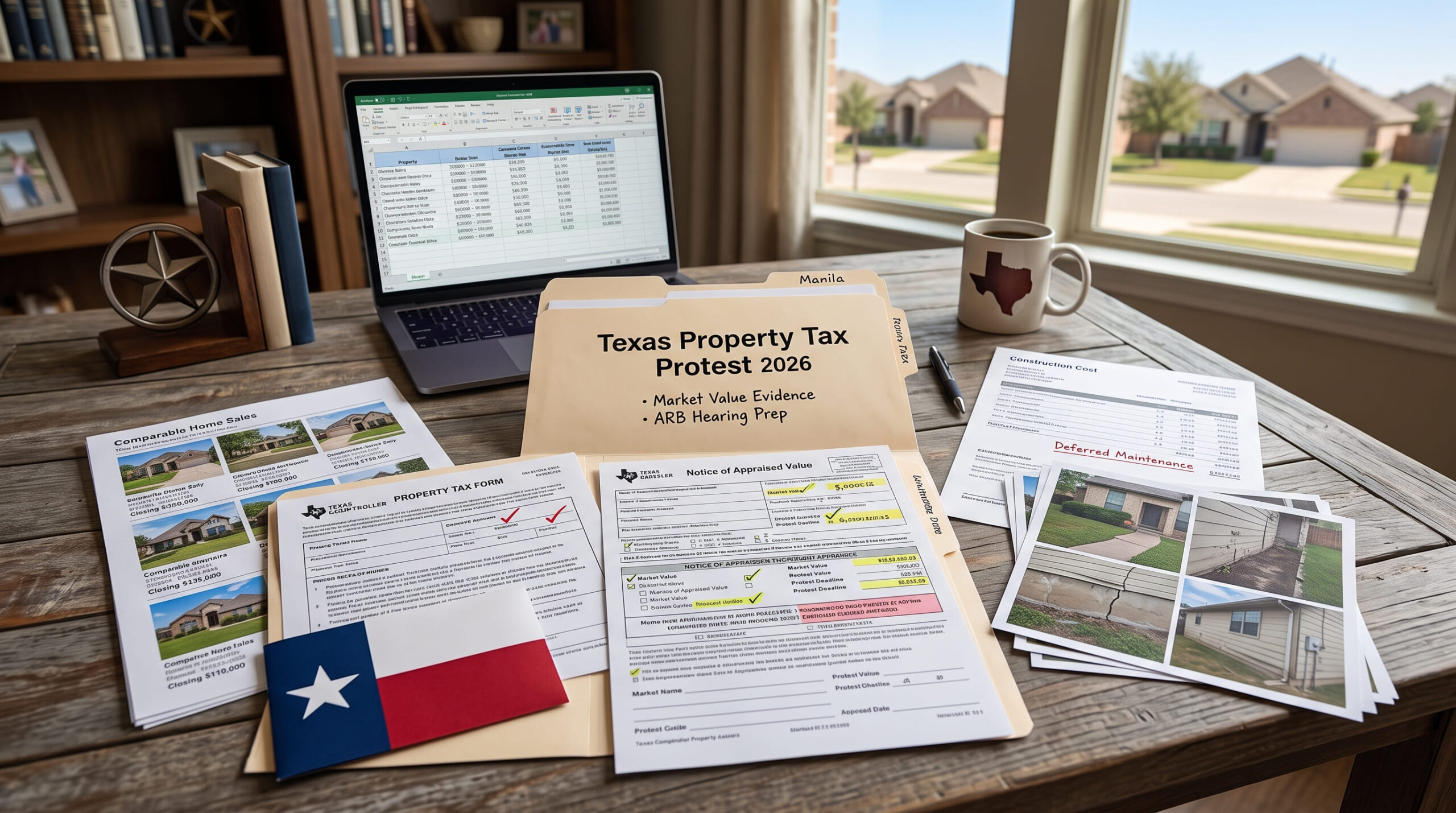
How to Protest Property Taxes in Texas & Win: 2026 Guide
A strong Texas property tax protest starts with the right protest ground, a timely filing, and evidence that directly addresses the appraisal district's value or another appraisal issue. This guide walks through the process from your Notice of Appraised Value through the informal review, Appraisal Review Board hearing, and post-ARB appeal options.
To protest property taxes in Texas, review your Notice of Appraised Value and appraisal record, identify the protest grounds, file a written Notice of Protest by the applicable deadline, request the appraisal district's hearing evidence, prepare property-specific evidence, attend any informal review, and present the unresolved protest to the Appraisal Review Board. If you disagree with the ARB's written order, district court, regular binding arbitration, or SOAH may be available depending on the property and issue. No strategy guarantees a reduction, but a timely, evidence-based case gives the ARB a concrete basis to change the appraisal.
How to Protest Property Taxes in Texas: 8 Steps
1
Review the Notice
Check market value, appraised value, exemptions, limitations, and property-record facts.
2
Choose Protest Grounds
Identify market value, unequal appraisal, exemption, property-record, or other issues that actually apply.
3
File on Time
Submit the written protest before the deadline shown on your notice.
4
Request District Evidence
Ask for the data and other information the appraisal district intends to use at the hearing.
5
Build Your Evidence
Organize sales, condition, income, cost, property-record, or unequal-appraisal evidence.
6
Use the Informal Review
Try to resolve the dispute with appraisal-district staff before the formal hearing.
7
Present at the ARB
Present a concise case tied to the protest ground and requested result.
8
Evaluate an Appeal
If the ARB result remains unfavorable, review the applicable post-ARB options immediately.
What Does “Winning” a Texas Property Tax Protest Mean?
There is no guaranteed way to “win” a property tax protest. A successful protest can mean obtaining a lower appraised value, correcting an unequal appraisal, fixing a factual error, restoring an exemption or appraisal limitation, or otherwise correcting the appraisal record.
The strongest strategy is not to argue that the tax bill feels too high. Focus on the issue the ARB has authority to decide and support the requested correction with credible evidence.
1
Review Your Notice of Appraised Value and Property Record
Start with the appraisal notice and the appraisal district's property record. Texas notices use terms such as market value, appraised value, exemptions, and taxable value. Do not treat “market value,” “appraised value,” and the final tax bill as the same number.
For qualifying single-family residence homesteads, required appraisal notices generally are sent by April 1 or as soon thereafter as practicable. For other property, the general notice date is May 1 or as soon thereafter as practicable when a notice is required.
Check square footage, land size, age, quality, condition, improvements, property type, exemptions, ownership, appraisal limitations, and any other characteristics that could affect the appraisal.
2
Identify the Correct Property Tax Protest Grounds
Texas protest rights are broader than simply saying the value increased. A property owner may protest the appraised or market value and other appraisal-district actions concerning the property.
Common protest grounds include:
Market value: the appraisal district's value exceeds a supportable January 1 market value.
Unequal appraisal: the property is appraised unequally compared with an appropriate sample of comparable properties.
Property-record errors: the district is relying on incorrect size, age, condition, improvements, classification, or other facts.
Exemption issues: an exemption was denied, canceled, reduced, or omitted.
Appraisal limitations: a residence-homestead cap, qualifying circuit breaker, or other applicable limitation was not handled correctly.
Special appraisal or other district action: agricultural/special appraisal qualification or another action concerning the property may be protestable depending on the facts.
File the Notice of Protest Before the Texas Deadline
For most owners, the usual Texas property tax protest deadline is May 15 or 30 days after the appraisal district mails the Notice of Appraised Value, whichever is later, according to the Texas Comptroller's current taxpayer guidance.
The Tax Code describes the deadline in relation to delivery of the required notice, while the Comptroller instructs taxpayers to count the 30-day period from the date the appraisal district mails it. The safest approach is to use the filing deadline printed on your notice and submit the protest early.
The Comptroller provides Form 50-132, Property Owner's Notice of Protest. A protest can also be sufficient without that exact form if the written notice properly identifies the property, owner, and subject showing dissatisfaction with the appraisal-district decision.
If you appoint someone to represent you, Texas owners generally use Form 50-162, Appointment of Agent for Property Tax Matters.
Do not prepare your case without seeing what the appraisal district plans to use.
At least 14 days before the hearing, the appraisal district must provide required taxpayer materials and inform the owner about the right to request the data, schedules, formulas, and other information the chief appraiser intends to introduce at the hearing. Requested hearing evidence must be provided without charge.
Requested information that is not timely delivered generally cannot later be used or offered as evidence at the hearing. This makes the evidence request one of the most important procedural steps in a Texas property tax protest.
5
Build Evidence That Matches the Protest Ground
The best evidence depends on why you are protesting. A large evidence packet is not automatically a strong packet. The goal is to show, in a clear sequence, why the appraisal record should be changed.
Evidence
How It Can Help
Comparable sales and closing documents
Support a market-value position when the sales are relevant to the property and appraisal date.
Photos, inspections and repair estimates
Document condition, damage, deferred maintenance or features the appraisal may not reflect.
Comparable appraisal records
Support an unequal-appraisal analysis when the comparison set and adjustments are appropriate.
Leases, rent rolls, vacancy, income and expenses
Support income-related valuation issues for commercial, multifamily and other income-producing property.
Cost data and depreciation information
Support cost-approach or obsolescence issues where appropriate.
Surveys, plans, engineering reports and deed records
Support property-specific corrections involving size, use, site, access, construction, ownership or physical characteristics.
Independent appraisal
Can provide a supported alternative opinion of value and, in certain qualifying §41.43 cases, may affect the appraisal district's evidentiary burden.
Many appraisal districts offer an informal conference before the formal ARB hearing. The purpose is to see whether the owner and district can resolve the protest without requiring an ARB determination.
Bring the same core evidence you would rely on at the ARB. Explain the property, identify the protest ground, state the value or correction you are requesting, and show the evidence supporting that result.
If the informal resolution is acceptable, the protest may end there. If not, continue to the ARB hearing rather than accepting a result you do not believe is supported.
7
Present a Focused Case at the Appraisal Review Board Hearing
At the formal ARB hearing, the owner or authorized representative and appraisal district each have an opportunity to present evidence, examine witnesses, and argue the protest. Testimony is under oath.
The property owner may elect whether to present evidence before or after the appraisal district representative. Use that choice strategically. Some owners prefer to hear the district's case first so they can respond directly to its evidence.
Keep the presentation organized:
State the property and protest ground.
State the correction or value you are requesting.
Present your strongest evidence first.
Explain why the district's evidence does not support its conclusion.
Answer the panel's questions directly.
End with the exact value or correction you want the ARB to order.
Review the ARB Written Order and Any Appeal Deadline Immediately
The ARB determines the protest by written order. If you remain dissatisfied, the next step is generally an appeal, not another initial protest.
Depending on the property and issue, options may include:
District court: petition generally must be filed within 60 days after receiving the ARB's written order.
Regular Binding Arbitration (RBA): qualifying owners generally must request arbitration within 60 days after receiving the ARB order. RBA is generally available for residence homesteads regardless of value and other qualifying property valued at $5 million or less.
SOAH: qualifying appeals generally require a notice within 30 days after receiving the ARB order and a $1,500 deposit within 90 days. Current Comptroller guidance says this option may apply to qualifying property over $1 million and does not apply to industrial property.
Who Has the Burden of Proof in a Texas Property Tax Protest?
For most protests of appraised value or unequal appraisal, Tax Code §41.43 generally places the burden on the appraisal district to establish the property's value by a preponderance of the evidence. If the district fails to meet that standard, the protest is determined in favor of the property owner.
Situation
General Evidentiary Rule
Most market-value / unequal-appraisal protests
The appraisal district generally bears a preponderance-of-the-evidence burden.
Qualifying property valued at $1 million or less with a compliant recent certified appraisal timely delivered
The appraisal district can face a clear-and-convincing evidence burden if §41.43's detailed requirements are satisfied.
Prior-year value was lowered through the protest/appeal process and the owner timely provides qualifying information
The appraisal district can face a clear-and-convincing evidence burden when the statutory conditions are met.
Owner failed to provide certain required rendition/property-report information
The burden may shift to the property owner under §41.43(d).
Practical point: even when the appraisal district formally has the burden of proof, do not show up with no evidence. A well-organized owner presentation helps the ARB understand exactly why the requested value or correction is supported.
Can the ARB Raise Your Property Value Because You Protested?
For a protest of appraised value, the ARB generally may not determine a value higher than the value shown in the appraisal records submitted by the chief appraiser unless the property owner requests and agrees to the higher value. The statute contains exceptions for certain exemption and special-appraisal disputes.
That does not mean protesting is automatically “risk-free.” Owners still need to consider deadlines, evidence, professional fees if any, and whether the dispute may continue after the ARB.
Should You Protest Market Value, Unequal Appraisal, or Both?
They are different legal theories.
Market Value
The argument is that the appraisal district's value exceeds a supportable market value for the property as of the relevant appraisal date.
Unequal Appraisal
The argument is that the property is appraised unequally compared with an appropriate sample of other properties under Texas law.
Other Grounds
Exemptions, property-record errors, appraisal limitations and other district actions can require different evidence and remedies.
Preserve every protest ground that actually applies to the facts. Do not rely on an unequal-appraisal argument simply because another property has a lower value; the statutory comparison method matters.
7 Common Mistakes That Weaken a Texas Property Tax Protest
Missing the filing deadline. File the written protest before the deadline even if the evidence packet is not finished.
Arguing only that the tax bill is too high. The appraisal district and ARB decide appraisal issues; local taxing units set tax rates.
Failing to request the appraisal district's evidence. You should understand the district's case before the hearing.
Using irrelevant comparables. Strong evidence must actually relate to the protest ground and property.
Ignoring unequal appraisal. A market-value case and an equal-and-uniform case are different and may support different arguments.
Submitting evidence without explaining it. Tell the ARB what each exhibit proves and the result it supports.
Waiting after the ARB order. Post-ARB deadlines can run quickly, including 30- and 60-day windows.
Do You Need a Property Tax Protest Company or Attorney?
No professional is required merely to file an ordinary Texas property tax protest. An owner can file and present the protest personally or appoint an authorized agent.
Professional help may make more sense for high-value property, commercial or income-producing property, complex unequal-appraisal issues, portfolios, difficult evidence, limited owner time, or disputes likely to continue after the ARB.
A protest is worth evaluating when there is a supportable appraisal issue and enough potential tax impact to justify the effort or professional cost. The answer is not automatically yes for every owner or every year.
Review the appraisal notice and property record, identify the protest grounds, file a written protest on time, request the appraisal district's evidence, prepare your evidence, use any informal review, and present unresolved issues to the ARB.
What is the Texas property tax protest deadline?
The usual deadline is May 15 or 30 days after the appraisal district mails the Notice of Appraised Value, whichever is later, under the Comptroller's current taxpayer guidance. Use the deadline stated on your notice and file early.
How can I protest property taxes and win?
No strategy guarantees a reduction. The strongest approach is to file on time, choose the correct protest ground, request the district's evidence, use credible property-specific evidence, and clearly explain the exact value or correction you want the ARB to order.
What evidence is best for a Texas property tax protest?
Useful evidence can include comparable sales, closing documents, photos, repair estimates, inspection reports, comparable appraisal records, leases, rent rolls, income and expenses, cost information, surveys, engineering reports and independent appraisals. The best evidence depends on the protest ground.
Who has the burden of proof at a Texas ARB hearing?
For most market-value and unequal-appraisal protests, the appraisal district generally has the burden of establishing value by a preponderance of the evidence. Clear-and-convincing standards or a shift in burden can apply in specific circumstances under Tax Code §41.43.
Can the ARB increase my property value if I protest?
For an appraised-value protest, the ARB generally may not set the value above the value submitted in the appraisal records unless the owner requests and agrees to the higher amount. Statutory exceptions apply to certain exemption and special-appraisal disputes.
Can I protest my Texas property value every year?
Yes, a property owner may protest a current-year appraisal or other protestable appraisal-district action when the statutory requirements and deadline are met. A prior protest does not eliminate the right to review the next year's appraisal.
Do I need a property tax consultant or attorney to protest?
No. An owner may file and present a protest personally or appoint an authorized representative. Professional representation is a cost-benefit decision based on the property's complexity, amount at stake, evidence, time and possible post-ARB issues.
What happens if I lose at the ARB?
Depending on the property and issue, a dissatisfied owner may be able to appeal through district court, regular binding arbitration, or SOAH. Different eligibility rules, tax-payment requirements, deposits and deadlines apply.
PropertyTaxes.Law can review the appraisal, identify potential market-value or unequal-appraisal issues, analyze the appraisal district's evidence, and help prepare and present the protest through the administrative process.
This article provides general educational information and is not legal, tax, appraisal or financial advice. Protest rights, deadlines, evidence rules, burden-of-proof standards, appraisal methods and appeal options depend on the property, tax year, appraisal district and facts. Confirm the deadline shown on your notice and current procedures with the applicable appraisal district and official Texas sources, and consult qualified Texas counsel when legal advice is needed.
Brandon and his team have proven they can perform with any product type we give them,
from industrial and office property to single and multi-family residential.
- HunterBrown, InSite Realty Partners, L.P.
At a critical time when a property was in lease-up, we were faced with an unreasonable and unjustified assessment.
Brandon’s tenacity and responsiveness resulted in a fair assessment and the largest value change I've seen in my career.
- Jeremy Bartholomew
Outstanding!! These guys are pros - they are great at what they do and great to work with.
- David Denenburg, Denenburg Interests, LLC / Station 3