

Compare official 2025 county-government property tax rates for major Texas counties, then learn how school, city and special-district rates combine on an individual property. Every table identifies its tax year, source date and limitations, with links to the local 2026 Truth-in-Taxation database for current figures.
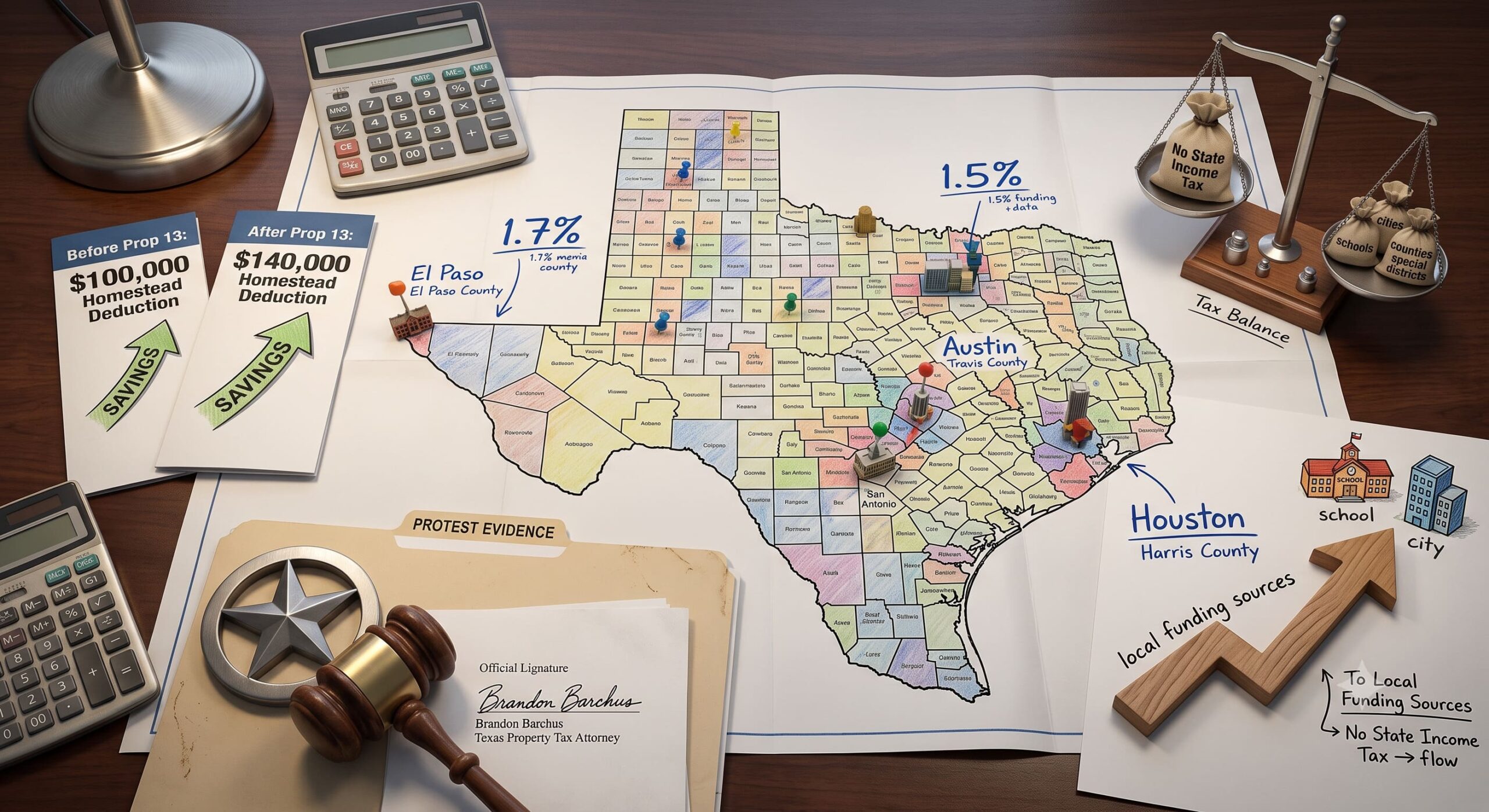
Texas has no state property tax. Local counties, school districts, cities and special districts adopt their own rates, so two homes in the same county can have different combined rates. The county rate shown below is one official component of the bill, not the property's complete combined rate.
There is no single Texas property tax rate. In the official 2025 Comptroller data, the county-government component among the 18 counties featured below ranges from $0.149343 to $0.824000 per $100 of taxable value. A property's complete rate also includes every applicable school, city and special-district rate.
These three terms get used interchangeably in casual conversation, but they mean different things — and confusing them is a common source of "why doesn't this number match my bill" confusion.
An observed ratio: annual residential property tax paid divided by the property's market value. It is useful for broad comparisons but is not an adopted rate and may reflect exemptions.
The statutory benchmark designed to raise approximately the same property-tax revenue from property taxed in both years, after required adjustments. It is not automatically the adopted rate.
The actual rate a taxing unit's governing body votes to approve for the year, set at or after its Truth-in-Taxation hearing. This is the rate that determines your actual bill for that unit.
The sum of every adopted rate applicable to one property. Because exemptions can produce different taxable values for different units, the most accurate bill estimate calculates each unit separately.
The table below uses the official adopted county-government rate reported to the Texas Comptroller. It does not add school, city, hospital, college, emergency-service, utility or other special-district rates.
These are adopted county-government rates per $100 of taxable value, not estimated household effective rates. They come from the Texas Comptroller's official 2025 statewide rate file. Sort any marked column, download the CSV, or open the county's local rate database to check current 2026 proposals and adoptions.
Source dates: tax year 2025; statewide list published December 30, 2025; county spreadsheet version January 28, 2026; page accessed September 23, 2026. Rates are expressed as dollars per $100 of taxable value. For example, $0.380960 per $100 equals 0.380960%.
Source: Texas Comptroller, 2025 Tax Rates and Levies, County Rates and Levies spreadsheet. Click or keyboard-activate any marked column header to sort.
The statewide file reports the county's total rate across county funds. It does not represent the full combined rate for a particular address, and fund applicability can vary. Confirm the taxing units, taxable value and adopted rates shown on the property's official local record before making financial decisions. Color highlights identify the highest and lowest three county components within this featured 18-county set only.
The figures below isolate the official 2025 county-government component for six major metro counties. They are not citywide combined rates. Use the local database for the property's school, city and special-district components.
Harris County component only. Add the applicable city, school and special-district rates for the address. See our Houston property tax attorney page for local guidance.
Dallas County component only. Dallas College, Parkland Hospital, city and school rates may also apply, depending on the property.
Travis County component only. The property's municipality, school district, healthcare and other applicable units determine the complete rate.
Bexar County component only. City, school and special-district boundaries can change the total from one address to another.
Tarrant County component only. Fort Worth and neighboring cities and school districts adopt separate rates.
El Paso County component only. Add the school, city, hospital and other applicable local-unit rates shown for the property.
Many property owners assume their tax rate is fixed or set at the same time every year. In reality, Texas property taxes follow an annual cycle where values and rates are determined separately — and rates aren't finalized until months after most people expect.
| Timeframe | What Happens |
|---|---|
| April – May | Property values are appraised and Notices of Appraised Value are mailed to owners. |
| May – July | Protest filings and Appraisal Review Board hearings are conducted. |
| Late July | Appraisal rolls are certified for most counties. |
| August – September | Taxing units calculate benchmark rates, publish notices, adopt budgets and hold hearings when required. |
| September 29, 2026 | General 2026 deadline to adopt the current-year rate, or before the 60th day after receiving the certified appraisal roll, whichever is later. |
| October 1 or soon after | Tax assessors generally begin mailing current-year property tax bills. |
Source: Texas Comptroller 2026 Property Tax Law Deadlines. Exact dates and exceptions can vary, so confirm the applicable local notice and database.
Truth-in-Taxation is the notice-and-rate-adoption framework Texas taxing units follow. Depending on the proposed rate and the type of taxing unit, public-notice, hearing and election requirements may apply before adoption.
A Truth-in-Taxation hearing is a public meeting held when the applicable statutory requirements trigger one. It lets taxpayers review the proposed rate and revenue effect and comment before the governing body votes.
These hearings generally occur after appraisal rolls are certified and before the applicable adoption deadline. Attending — or at least reviewing the proposed rate beforehand — is one of the only ways a property owner can respond to a rate increase directly, separate from protesting your property's appraised value.
Your property tax bill is calculated by multiplying your taxable value (appraised value minus any exemptions) by the combined tax rate for every taxing unit that covers your property — school district, county, city, and any special districts.
Your county appraisal district estimates your property's market value as of January 1 each year.
The 2026 general residence homestead exemption removes $140,000 from school-district taxable value. The additional school exemption for qualifying over-65 or disabled homeowners is $60,000. See the Comptroller's January 2026 update and our exemptions guide.
Calculate each taxing unit separately because the taxable value and exemptions can differ by unit. Then add the unit-level taxes to estimate the total bill.
Use our property tax calculator to estimate the bill. If the value appears unsupported, follow our guide to protesting property taxes in Texas or review our professional protest services.
For each taxing unit: (taxable value ÷ 100) × adopted rate = tax for that unit. Add the unit-level results. Do not apply one combined rate to one taxable value unless every unit uses the same taxable value.
The following examples show why exemptions must be applied before rates are multiplied. The rates are hypothetical and are used only to demonstrate the calculation method.
Assumptions: $400,000 appraised value; $140,000 school homestead exemption; no other exemptions; hypothetical rates of $1.00 school, $0.25 county, $0.60 city and $0.15 special district per $100.
Without the school exemption, the same hypothetical rates would produce $8,000. Local-option exemptions may reduce other unit-level taxable values.
Assumptions: the same $400,000 value and rates, plus the 2026 $60,000 additional school exemption for a qualifying over-65 or disabled homeowner.
This is $600 below Example 1 solely because of the additional school exemption. It does not model local exemptions, the school-tax ceiling, appraisal limitations or property-specific eligibility.
The table reproduces the Total County Tax Rate field for 18 featured counties from the Texas Comptroller's 2025 County Rates and Levies spreadsheet. Appraisal districts report these rates to the Comptroller under Tax Code Section 5.091. The downloaded records are labeled "Working" and versioned January 28, 2026, so later Comptroller corrections may supersede them.
Known limitations:
For an address-specific result, identify every taxing unit and taxable value in the official Texas property tax directory, calculate each unit separately, and compare the estimate with the county tax bill.
Dataset use and attribution: PropertyTaxes.Law permits reuse of its 18-county selection and presentation with attribution to PropertyTaxes.Law and the Texas Comptroller of Public Accounts. This permission applies only to PropertyTaxes.Law's compilation and presentation. The underlying Comptroller data remains subject to applicable source terms and law. The comparison is provided for informational purposes without warranties; users should verify current figures with the official sources linked above.
2026 statewide update timing: appraisal districts must report adopted 2026 rates to the Comptroller by October 15, 2026, and submit post-election updates by November 17. The statewide list is published no later than January 1 of the following year. Until then, the linked county databases are the appropriate source for current local proposals, notices and adopted rates.
An individual owner generally cannot change an adopted rate through an appraisal protest. You can, however, review whether exemptions are applied and whether evidence supports challenging the appraisal district's value, property description or unequal treatment.
For the complete strategy, see our guide on how to reduce property taxes in Texas.
An appraisal protest does not change an adopted tax rate, but it can challenge an unsupported value or another protestable appraisal-district action. PropertyTaxes.Law provides attorney-backed protest support with no upfront cost.
Start Your Property Tax ProtestBrandon and his team have proven they can perform with any product type we give them,
from industrial and office property to single and multi-family residential.
At a critical time when a property was in lease-up, we were faced with an unreasonable and unjustified assessment.
Brandon’s tenacity and responsiveness resulted in a fair assessment and the largest value change I've seen in my career.
Outstanding!! These guys are pros - they are great at what they do and great to work with.