

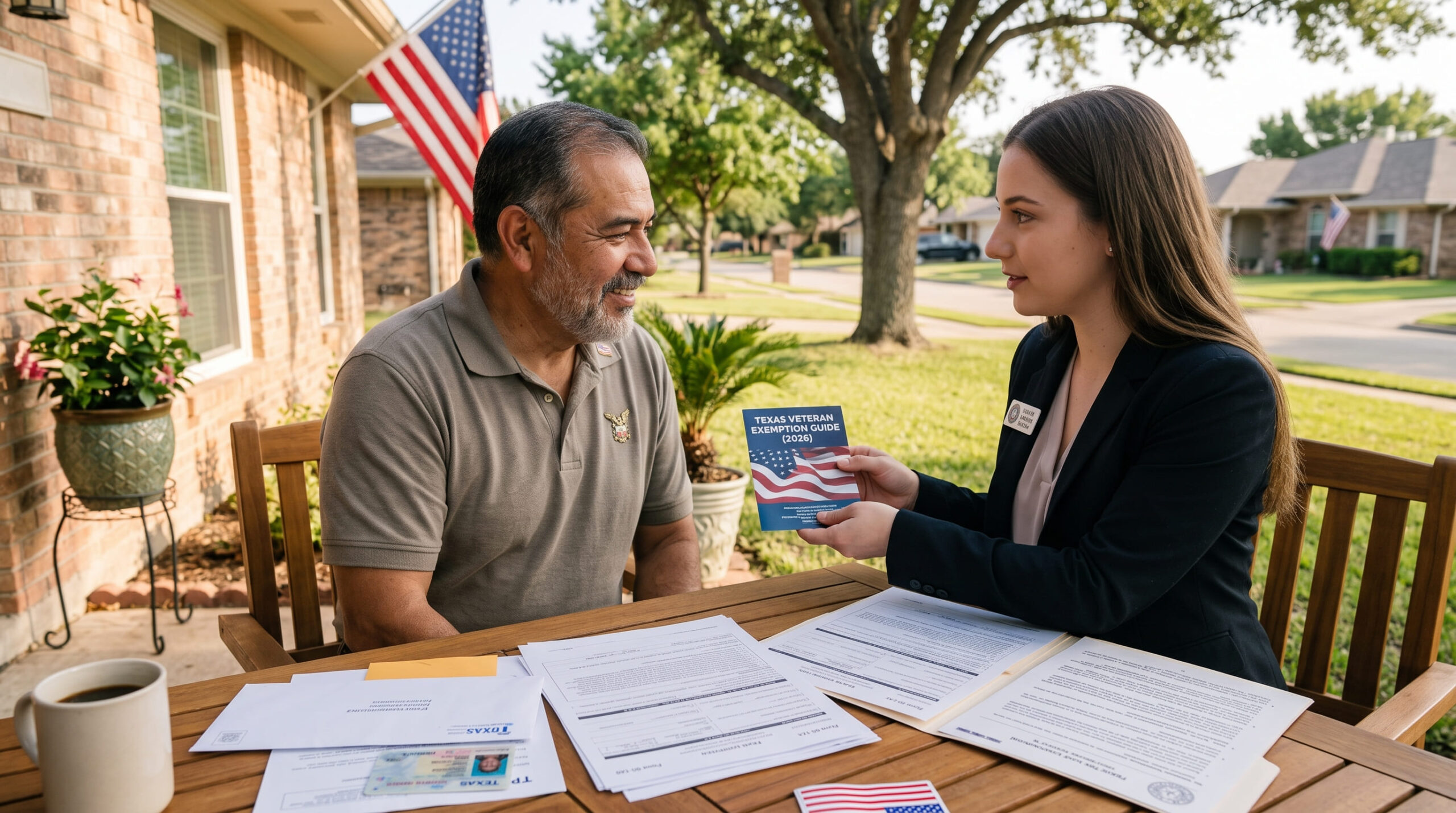
It depends on the veteran's VA disability rating. Texas veterans with a 100% VA disability rating (or a VA determination of Individual Unemployability) pay zero property tax on their homestead — a complete exemption under Tax Code §11.131. Veterans with a partial disability rating (10%–99%) receive a fixed-dollar exemption based on their rating, ranging from $5,000 to $12,000 off the appraised value of one property they own. Veterans with no VA disability rating pay property taxes like any other Texas homeowner, though they still qualify for the standard homestead exemption on their primary residence.
Looking for the general (non-military) disability exemption? This page covers the veteran-specific exemption tied to a VA disability rating. If your disability is not connected to military service, see our Texas Disabled Person Property Tax Exemption guide instead — it covers a different Tax Code provision with different eligibility rules.
Under Tax Code §11.22, a disabled veteran's property tax exemption is based directly on their VA disability rating. This exemption can be applied to any one property the veteran owns and designates — it is not limited to a homestead.
| VA Disability Rating | Exemption Amount (Off Appraised Value) |
|---|---|
| 10% – 29% | $5,000 |
| 30% – 49% | $7,500 |
| 50% – 69% | $10,000 |
| 70% – 99% | $12,000 |
| 100%, or VA Individual Unemployability | Full exemption of homestead value (see below) |
Source: Texas Tax Code §11.22 and §11.131; Texas Comptroller Form 50-135. Confirmed current as of September 2026.
These amounts apply to all taxing units — county, city, school district, and special districts — unlike the standard homestead exemption, which applies only to school district taxes. A disabled veteran exemption stacks on top of, and is separate from, the standard residence homestead exemption; a qualifying veteran can claim both. See our Texas Property Tax Exemptions guide for how the standard homestead exemption works.
Tax Code §11.131 is a separate, more powerful provision from the rating-based table above. A veteran who receives a 100% disability rating from the VA — or a VA determination of Individual Unemployability — is entitled to a total exemption of their residence homestead's appraised value. There is no dollar cap and no income limit: every dollar of property tax on the homestead is eliminated for as long as the veteran owns and occupies it as their primary residence.
Unlike the partial (§11.22) exemption, the 100% total exemption applies only to the veteran's homestead — it cannot be designated to a different property. A veteran with a 100% rating who also owns a second property would use the partial exemption table above for that additional property, not the total exemption.
If yes → You likely qualify for a total exemption on your homestead under §11.131. Skip to How to Apply.
If yes → You qualify for a partial exemption of $5,000–$12,000 under §11.22 on one property you designate.
If yes → You may be able to continue or newly claim the exemption. See Surviving Spouse & Child below.
The veteran-specific exemption does not apply, but you still qualify for the standard homestead exemption like any Texas homeowner. See our exemptions guide. Veterans 65 or older should also review the over-65 exemption, which can be combined with a veteran rating if applicable.
Texas law extends disabled veteran property tax benefits to surviving family members in two distinct situations:
Remarriage generally ends the exemption for a surviving spouse claiming under any of these provisions. If you are a surviving spouse and your marital or residency status has changed, contact your county appraisal district to confirm how it affects your exemption before assuming it continues automatically.
VA disability rating letter showing your current percentage rating or Individual Unemployability determination.
Form 50-135 (Application for Disabled Veteran's or Survivor's Exemption) for the partial-rating or survivor exemption.
Form 50-114 (Residence Homestead Exemption Application) with the disabled-veteran section completed, generally used for the 100% total exemption.
Proof of residency — typically a Texas driver's license or state ID matching the homestead address.
For surviving spouses: proof of marriage to the veteran and documentation of the veteran's death.
Request your most recent VA disability rating letter if you don't already have a copy, since the appraisal district will need current documentation.
Use Form 50-135 for a partial-rating or survivor exemption, or Form 50-114 (veteran section) for the 100% total homestead exemption.
Submit the completed application and documentation to the appraisal district for the county where the property is located — not to the Comptroller's office directly.
The general filing deadline is April 30. Late filing is available in most cases — confirm your specific situation with your appraisal district, since retroactive filing rules can differ from other exemption types. See our Texas property tax deadlines guide.
After approval, review your appraisal notice and tax bill to confirm the exemption was applied correctly.
The disabled veteran exemption is tied to the specific property you designate, not portable automatically like some other appraisal limitations. If you sell your home and buy a new one, you must file a new application for the exemption on the new property — it does not follow you without a new filing. If your rating changes (for example, increases to 100%), notify your appraisal district promptly, since a higher rating generally takes effect starting the following tax year.
Most veteran exemption applications are approved without issue when the VA documentation is current and complete. But denials happen — often due to a lapsed or outdated rating letter, a mismatch between the property address and your designated residence, or missing survivor documentation. If your application is denied:
If your exemption is denied or your homestead value is still too high after applying available exemptions, our attorney-backed reduction service reviews both issues together.
See our reduction services →If your disability is not connected to military service, a different exemption and eligibility path applies.
See the disabled person exemption guide →No. Texas veterans with a 100% VA disability rating, or a VA determination of Individual Unemployability, receive a total exemption from property tax on their homestead under Tax Code §11.131. There is no dollar cap and no income limit.
It depends on your VA disability rating: $5,000 for 10-29%, $7,500 for 30-49%, $10,000 for 50-69%, $12,000 for 70-99%, and a full homestead exemption for a 100% rating or Individual Unemployability determination.
The partial exemption (10%-99% ratings) can apply to any one property you own and designate, not just your homestead. The 100% total exemption applies only to your residence homestead.
Yes, in most cases, as long as the surviving spouse remains unremarried and continues to live at the same homestead. A separate provision also covers surviving spouses of service members killed in the line of duty, regardless of the veteran's prior disability rating.
A current VA disability rating letter, the appropriate application form (50-135 for partial/survivor exemptions, or Form 50-114 for the 100% total exemption), and proof of Texas residency.
Review the appraisal district's stated reason for denial, gather documentation addressing it, and file a protest with the Appraisal Review Board if you believe the denial was incorrect. Complex cases, especially disputed Individual Unemployability determinations, may benefit from legal representation.
No. The exemption is tied to the specific property on file. If you move, you must file a new application for the exemption on your new property.
Exemption amounts, forms, and retroactive filing rules can change. Confirm current requirements with your county appraisal district and consult qualified counsel before making a financial or legal decision.
PropertyTaxes.Law helps Texas veterans and surviving spouses secure the exemptions they're entitled to and challenge denials with attorney-backed representation.
Get Help With Your Veteran ExemptionThis article provides general educational information and is not legal, tax, or VA-benefits advice. Eligibility, exemption amounts, forms, and filing deadlines can vary by individual circumstances and are subject to change. Confirm your specific situation with your county appraisal district, the Texas Veterans Commission, or qualified counsel.
Brandon and his team have proven they can perform with any product type we give them,
from industrial and office property to single and multi-family residential.
At a critical time when a property was in lease-up, we were faced with an unreasonable and unjustified assessment.
Brandon’s tenacity and responsiveness resulted in a fair assessment and the largest value change I've seen in my career.
Outstanding!! These guys are pros - they are great at what they do and great to work with.