

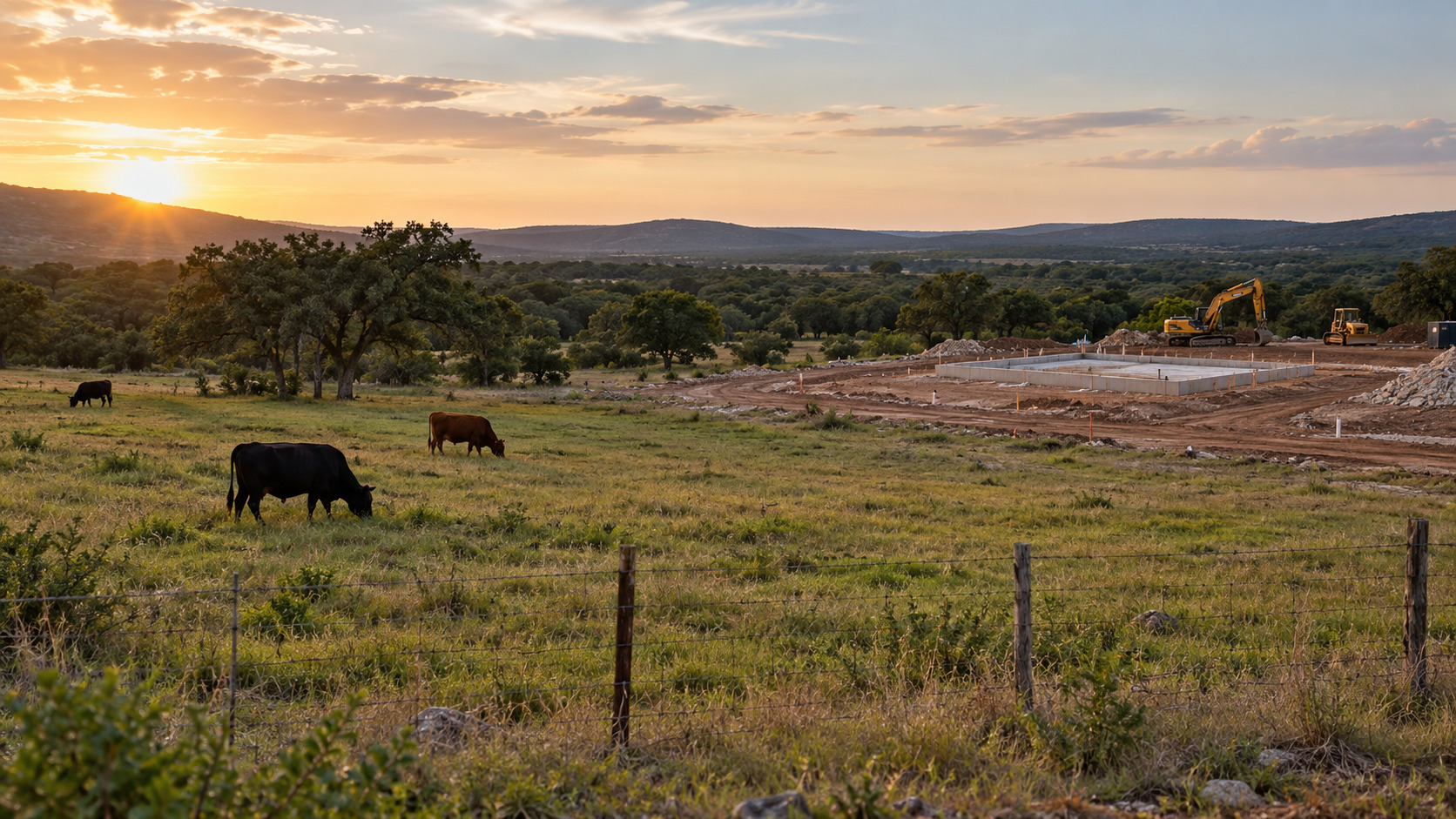
Rollback taxes are an additional tax imposed when land that received special agricultural, timber or open-space appraisal changes to a non-qualifying use. For most ag land (1-d-1), the tax equals the difference between the taxes paid on the land's productivity value and the taxes that would have been paid on its market value for each of the three years before the year the use changed (Tax Code §23.55). Since 2021 there is no interest on a 1-d-1 rollback unless the bill becomes delinquent. A sale alone does not trigger a 1-d-1 rollback; a change of use does.
This guide covers rollback exposure, calculation, deadlines and closing allocation. For how land qualifies for agricultural valuation in the first place, see our Texas agricultural exemption guide.
Texas lets qualifying farm, ranch, timber and wildlife land be appraised on its capacity to produce (productivity value) instead of its market value. People call this an "ag exemption," but it is a special valuation, not an exemption. Appraisal districts keep track of both values every year, and the gap between them is the tax that was deferred while the land stayed in qualifying use.
When the use changes, the law "rolls back" and collects part of that deferred tax. The tax is imposed on the land, and a tax lien attaches on the date the change of use occurs (§23.55(b)). That is why rollback exposure follows the property through a sale and has to be dealt with in the purchase contract.
| Special Appraisal Type | Rollback Statute | What Triggers It | Look-Back & Interest |
|---|---|---|---|
| 1-d-1 open-space agricultural (most ag land, including wildlife management) | §23.55 | Change of use | 3 years; no interest unless the bill becomes delinquent |
| 1-d agricultural (individual owner whose primary occupation and income is farming) | §23.46 | Sale or diversion to non-agricultural use | 3 years plus interest at the delinquent-tax rate |
| Timberland | §23.76 | Change of use | 3 years; no interest unless delinquent |
| Restricted-use timberland | §23.9807 | Change of use, including early harvest | 3 years; no interest unless delinquent |
| Recreational, park or scenic land | §23.86 | Change of use or expired deed restriction | 3 years; no interest unless delinquent |
Source: Texas Tax Code Chapter 23 as amended through 2025. Most Texas ag land is appraised under 1-d-1; check your appraisal district record to confirm which category applies.
Terminology trap: the rollback tax on land is not the old "rollback tax rate." In 2019, Senate Bill 2 renamed that tax-rate limit the voter-approval tax rate. "Recapture" in Texas usually refers to school finance, where property-wealthy school districts send part of their local revenue to the state. Neither has anything to do with a rollback bill on ag land.
Under §23.55(e), the chief appraiser of the appraisal district decides whether a change of use has occurred. A change of use is a physical change in how the land is used, such as development or ending agricultural use. Use this matrix as a starting point, then confirm with the appraisal district where the land is located.
| Event | Rollback? | Why |
|---|---|---|
| Developing the land (subdivision, commercial site, solar or industrial project) | Yes | The land changes to a non-qualifying use (§23.55(a)). |
| Ending agricultural use (cattle removed, fields abandoned outside normal rotation) | Generally yes | Ceasing agricultural use can be treated as a change of use. The chief appraiser decides based on the facts. |
| Changing use on part of the tract (a homesite, barn pad or road) | Yes, that part only | The rollback applies only to the portion whose use changed (§23.55(d)). |
| Selling 1-d-1 land while the buyer keeps the qualifying use | No | A sale is not a change of use. The new owner may still need a new application. |
| Selling 1-d land | Yes | For 1-d land, a sale itself triggers additional taxes plus interest (§23.46(c)). |
| Claiming the land as part of your homestead | Not by itself | A homestead claim alone is not a change of use (§23.55(i)). |
| Reducing intensity below the local standard while still farming | Different penalty | Not a rollback, but the land can lose its valuation. Failing to report it can bring back-assessment for up to five prior years plus a 10% penalty (§23.54(h), (j)). |
| Switching to wildlife management or timber | No | Wildlife management is an agricultural use. A move to qualifying timber use is excluded (§23.55(g)). |
| Condemnation, right-of-way sale or transfer to a government for public use | No | These are statutory exceptions (§23.55(f)). For 1-d land taken by condemnation, the condemning entity owes the tax (§23.46(g)). |
| Governor-declared drought or out-of-state military deployment | No, if conditions are met | Eligibility continues when the owner intends to resume use and meets the notice rules (§§23.522, 23.523). |
| Oil and gas operations by a lessee | Not for the remaining land | Eligibility does not end for the part of the land that still qualifies. |
| Transfer to certain religious or charitable organizations, or small rural cemetery tracts | Often no | Narrow exceptions with strict conditions (§23.55(j), (l), (o), (p)). |
Sources: Texas Tax Code §§23.46, 23.54, 23.55; Texas Comptroller, Agricultural, Timberland and Wildlife Management Use Special Appraisal. Exceptions have conditions that are not all listed here. General educational information, not legal advice.
The statute does not split rollback taxes between buyer and seller. It imposes the tax on the land, the lien attaches on the date of the change, and the bill goes to the owner. In practice, whoever owns the land when the use changes receives the bill, unless the contract shifts the cost.
That is why Texas Real Estate Commission (TREC) promulgated contracts include a rollback paragraph. In the Farm and Ranch Contract, for example, Paragraph 13B says that if the sale or the buyer's use after closing results in additional taxes, penalties or interest for periods before closing, the buyer pays. If they result from the seller's use or change in use before closing, the seller pays. The obligation survives closing. Wording differs between forms and versions, so read the paragraph in your actual contract.
| Scenario | Who Typically Bears the Cost | What to Negotiate |
|---|---|---|
| Buyer will build a home or develop after closing | Buyer, under the standard TREC clause | Price adjustment, or a seller credit if the seller's valuation history inflates the bill |
| Seller cleared or stopped grazing before closing | Seller, under the standard TREC clause | An escrow holdback until the appraisal district rules |
| Developer buyer requires a "clean" tract | Often the seller, by special provision | Who files the change-of-use notice, and whether rollback is paid from sale proceeds at closing |
| Lender requires tax coverage in the title policy | Depends on the contract | Whether the rollback must be triggered and paid at closing. Ask the title company early. |
| Buyer keeps ranching through the same tenant | No rollback at closing | Confirm whether the valuation carries over without a new application (see HB 1244 below) |
Source: TREC Farm and Ranch Contract, Paragraph 13B (Prorations and Rollback Taxes). This is general information about standard form language, not advice on any specific contract.
Rollback taxes are only one tax issue in a land or commercial acquisition. For the wider review of rates, values and taxing units before you close, see our guide to analyzing the tax burden before buying commercial property in Texas.
For 1-d-1 land, the calculation is done separately for each of the three tax years before the year of the change, for each taxing unit (county, school district, city and special districts):
Rollback for each year = (taxes that would have been imposed on market value) − (taxes actually imposed on productivity value)
Total rollback = the sum of those three yearly differences, across all taxing units
The year the use changes is handled separately. The three rollback years are the years before the change. Texas courts have addressed whether an appraisal district can also tax the land at market value for the change year itself (Bexar Appraisal District v. Sivage Investments, 2014; McKinney Millennium, LP v. Collin Central Appraisal District, 2020). Ask the appraisal district how it is treating the current year before you sign a closing statement.
| Rollback years | 2023, 2024, 2025 |
| Productivity value each year | $10,000 |
| Market value 2023 / 2024 / 2025 | $750,000 / $800,000 / $850,000 |
| Combined tax rate (all units, assumed constant) | 2.00% |
| 2023: $15,000 on market value − $200 paid | $14,800 |
| 2024: $16,000 on market value − $200 paid | $15,800 |
| 2025: $17,000 on market value − $200 paid | $16,800 |
| Total rollback on all 50 acres | $47,400 |
| If only a 5-acre homesite changes use (same per-acre values) | $4,740 |
Hypothetical figures for illustration only. Actual rates differ by year and taxing unit, and exemptions can change the result. No interest is shown because the bill is assumed to be paid before delinquency. Not a prediction for any property.
A tax lien attaches to the land on the date the change of use occurs, in favor of every taxing unit (§23.55(b)).
The owner must notify the appraisal office in writing before May 1 after eligibility ends. Failing to do so can add a penalty of 10% of the tax difference for each year the valuation was wrongly allowed (§23.54(h)).
The chief appraiser must first send a written notice and a response form. If no reply arrives within 60 days, the district must make a reasonable effort to locate the owner (§23.551).
The chief appraiser sends a notice of the determination that explains your right to protest (§23.55(e)).
File a written protest with the appraisal review board no later than the 30th day after the notice is delivered (§41.44(a)). This is not the usual May 15 deadline.
If you do not protest, or the protest is decided against you, each taxing unit's assessor prepares and delivers the bill.
The bill becomes delinquent if not paid before the next February 1 that is at least 20 days after delivery. A bill delivered January 9 is delinquent February 1 that year; one delivered January 30 is not delinquent until February 1 of the next year. Penalties and interest then apply as for other delinquent taxes.
Sources: Texas Tax Code §§23.54, 23.55, 23.551, 41.44; Texas Comptroller, Manual for the Appraisal of Agricultural Land. See also our Texas property tax deadlines guide.
A property owner can protest a determination that a change in use has occurred to the appraisal review board (§41.41(a)). The 30-day clock runs from delivery of the notice, so check the delivery date the moment it arrives. Grounds that come up in practice include:
If the review board rules against you, its order can be appealed, but those routes have their own strict deadlines and payment requirements. Our property tax appeal services page explains how we handle review board appeals. To avoid penalties and interest, plan to pay any undisputed amount before the delinquency date.
Pull the appraisal district record. Confirm the valuation type (1-d-1, 1-d, timber or wildlife) and the market and productivity values for the last three years.
Estimate the rollback using the formula above and each year's tax rates.
Match the tax to your plan. If you will build, subdivide or stop the agricultural use, budget for the rollback.
Plan the application. From 2026, no new application is needed only if you use the land in materially the same way, overseen by the same people. Otherwise, file Form 50-129 before May 1.
Read Paragraph 13B and add special provisions for credits or escrow if needed.
Ask the title company whether your lender requires rollback taxes to be paid at closing.
For wildlife land, get the wildlife management plan and annual reports.
Disclose the valuation status and give the buyer the appraisal district history.
Do not change the use before closing unless the contract says who pays. Under the standard clause, a pre-closing change by the seller is the seller's bill.
Negotiate with developer buyers who triggers the rollback, when, and from whose proceeds it is paid.
Notify the appraisal district in writing before May 1 if eligibility ends, to avoid the 10% penalty.
Keep records of qualifying use (grazing leases, receipts, photos) in case a change-of-use determination is disputed.
Many older articles still say rollback reaches back five years at 7% interest. That is outdated. These are the changes that matter most:
| Law | Change | Why It Matters |
|---|---|---|
| HB 1464 (2015) | Added §23.551: extra notice to owners 65 and older before a change-of-use determination | Older owners get a chance to respond before being rolled back |
| HB 1743 (2019) | Cut the 1-d-1 and timber look-back from five years to three, and interest from 7% to 5% | The modern three-year calculation |
| SB 2 (2019) | Renamed the "rollback tax rate" the "voter-approval tax rate" | "Rollback" now usually refers only to the tax on land |
| HB 3833 (2021, eff. June 15, 2021) | Removed rollback interest for 1-d-1, timber and other special-use land, so interest applies only if the bill becomes delinquent. Applied the three-year look-back to recreational, park and scenic land, public-access airport property and restricted-use timberland | Lower bills, and consistent rules across special-use types |
| SB 725 (2021) | Made the condemning entity liable for 1-d additional taxes caused by condemnation | Owners whose 1-d land is taken do not pay the rollback |
| HB 1244 (2025, eff. Jan. 1, 2026) | Ownership is not treated as changed if the new owner uses the land in materially the same way, overseen by the same individuals, and some late applications must be accepted | Smoother transfers when the same operator keeps working the land |
Sources: enrolled bill text and analyses, Texas Legislature Online; Texas Comptroller. Which version of the law applies can depend on when the change of use occurred.
Rollback taxes are an additional tax imposed when land that received special agricultural, timber or open-space appraisal changes to a non-qualifying use. For most agricultural land (1-d-1), the tax is the difference between the taxes paid on the land's productivity value and the taxes that would have been paid on its market value for each of the three years before the year the use changed (Tax Code §23.55).
A change of use triggers a 1-d-1 rollback, such as developing the land, building on part of it or ending agricultural use. The chief appraiser of the appraisal district decides whether a change of use has occurred. A sale alone, a homestead claim, a switch to wildlife management and condemnation do not trigger a 1-d-1 rollback.
The bill goes to whoever owns the land when the use changes, because the tax and lien attach to the land. Under the standard TREC Farm and Ranch Contract, Paragraph 13B, the buyer pays if the sale or the buyer's use after closing causes the rollback, and the seller pays if the seller's use or change in use before closing caused it. Buyers and sellers can negotiate a different split.
For each of the three tax years before the year of the change, subtract the taxes actually imposed on the productivity value from the taxes that would have been imposed on the market value, using that year's rates for every taxing unit. Add the three differences together. If only part of the tract changed use, the calculation covers only that part.
Three years for 1-d-1 agricultural land and timberland. The look-back was cut from five years to three by HB 1743 in 2019, and HB 3833 in 2021 applied three years to recreational, park and scenic land, public-access airport property and restricted-use timberland. 1-d land also uses three years.
For 1-d-1 agricultural land and timberland, no interest is added unless the rollback bill becomes delinquent, following HB 3833 in 2021. Land appraised under the separate 1-d category still owes interest at the rate for delinquent taxes under Tax Code §23.46(c).
Not for 1-d-1 land. A sale is not a change of use, so no rollback is due if the buyer keeps the qualifying use, although the buyer may need to file a new application. Land appraised under the 1-d category is different: a sale itself triggers additional taxes plus interest.
After the chief appraiser's determination and any protest, each taxing unit sends a bill. The tax becomes delinquent if it is not paid before the next February 1 that is at least 20 days after the bill is delivered. After that, normal penalties and interest for delinquent taxes apply.
Yes. You can protest the chief appraiser's determination that a change in use occurred to the appraisal review board. The written protest must be filed no later than the 30th day after the notice of the determination is delivered, which is different from the usual May 15 deadline.
No. The rollback tax rate was the old name for the tax-rate limit above which a taxing unit's voters can force an election. Senate Bill 2 renamed it the voter-approval tax rate in 2019. The rollback tax discussed here is the additional tax on land that leaves special agricultural, timber or open-space appraisal.
PropertyTaxes.Law helps Texas landowners and buyers estimate rollback exposure, challenge change-of-use determinations and appeal review board decisions. See our property tax appeal services.
Talk to a Property Tax AttorneyThis article provides general educational information about Texas rollback taxes and is not legal, tax or accounting advice. Statutes, forms and appraisal district practices change, and outcomes depend on the facts of each property and contract. The dollar figures in the worked example are hypothetical. Confirm current requirements with the appraisal district, tax office or qualified counsel before buying, selling or changing the use of land.
Brandon and his team have proven they can perform with any product type we give them,
from industrial and office property to single and multi-family residential.
At a critical time when a property was in lease-up, we were faced with an unreasonable and unjustified assessment.
Brandon’s tenacity and responsiveness resulted in a fair assessment and the largest value change I've seen in my career.
Outstanding!! These guys are pros - they are great at what they do and great to work with.