

Qualifying disabled Texas homeowners may receive an additional school-district residence homestead exemption and a school-tax ceiling. This guide explains the exemption amount, eligibility requirements, application process, and the difference between disabled-person and disabled-veteran property tax benefits.
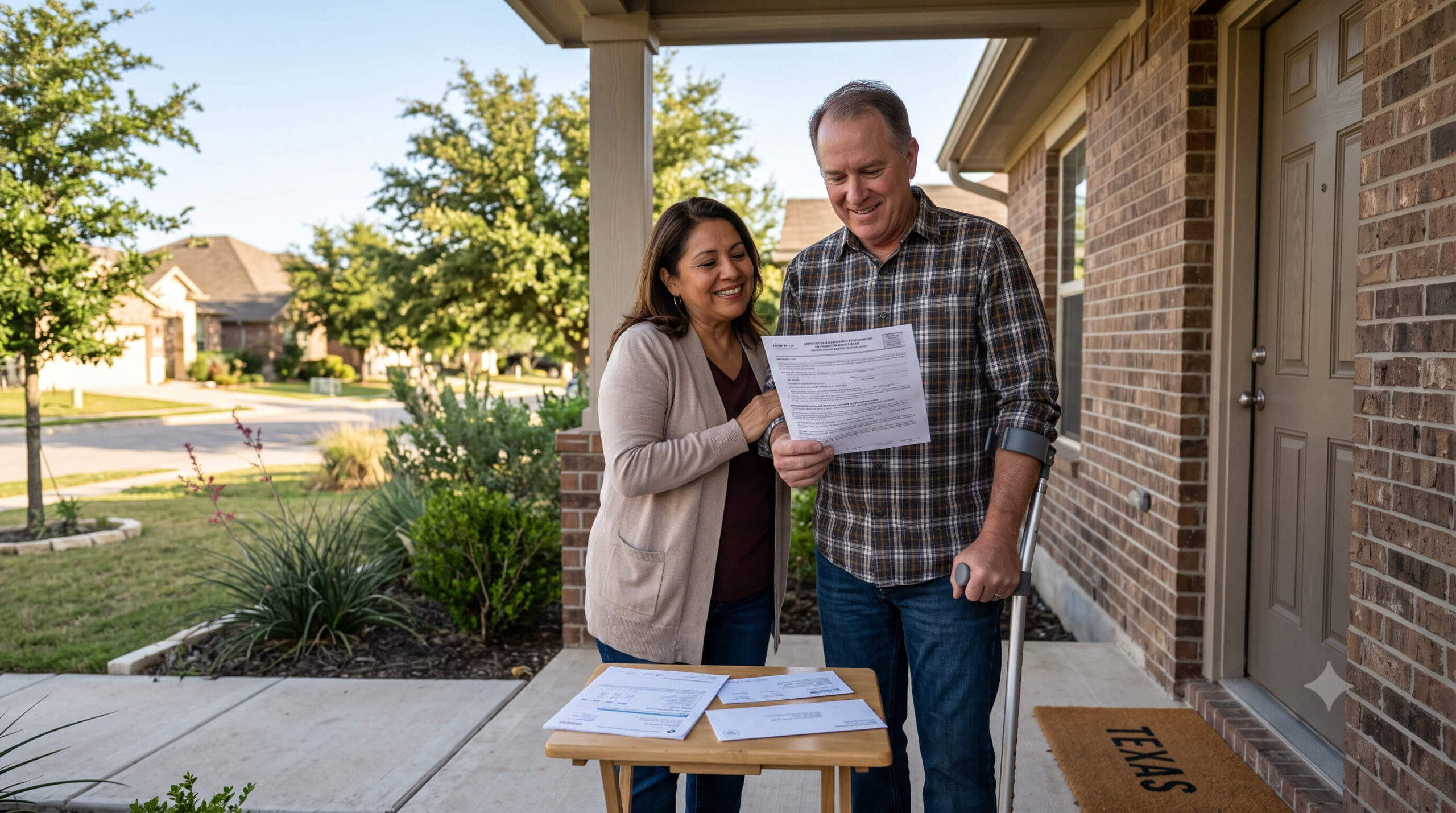
Texas offers a residence homestead property tax exemption for homeowners who meet the applicable disability standard. This benefit is separate from the exemptions available to disabled veterans and must be claimed through the county appraisal district where the home is located.
For a broader overview of homestead, senior, veteran, disaster, and other exemptions, visit our Texas property tax exemptions guide.
A qualifying disabled Texas homeowner may receive an additional $60,000 school-district residence homestead exemption. This is added to the general $140,000 school homestead exemption, potentially excluding $200,000 of the home's appraised value from school-district taxation. The homeowner must meet the applicable disability definition and use the property as a principal residence.
Example: If a qualifying disabled homeowner has a residence appraised at $400,000, the $140,000 general school homestead exemption plus the additional $60,000 disability exemption could reduce the value used to calculate school-district taxes to $200,000. Other taxing units, local exemptions, appraisal caps, and tax rates can affect the final bill.
To qualify for the disabled-person residence homestead exemption, the homeowner generally must meet the definition of disabled used for disability insurance benefits under the federal Old-Age, Survivors and Disability Insurance Act. Receiving benefits through another public or private disability program does not automatically establish eligibility.
The applicant must own an interest in the property for which the exemption is claimed.
The home must be the applicant's principal residence and qualify as a Texas residence homestead.
The applicant generally must meet the disability definition connected to federal Social Security disability insurance.
The appraisal district may request records establishing ownership, residence, identity, and disability eligibility.
For the 2026 tax year, school districts must provide an additional $60,000 exemption to a qualifying disabled homeowner. This benefit is added to the general school-district residence homestead exemption.
| Benefit | 2026 Amount or Rule | How It Applies |
|---|---|---|
| General School Homestead Exemption | $140,000 | Available to a qualifying Texas residence homestead. |
| Disabled-Person School Exemption | Additional $60,000 | Available to a qualifying disabled homeowner on a residence homestead. |
| Potential Combined School Exempt Value | $200,000 | The general and disabled-person school exemptions may be combined when the homeowner qualifies. |
| Local-Option Exemptions | Varies | Some cities, counties, and other taxing units may offer additional exemptions. |
The exemption does not freeze the home's market value and does not necessarily freeze every part of the property tax bill. Qualifying disabled homeowners generally receive a ceiling on school-district taxes imposed on the residence homestead.
Important: City, county, hospital district, and other property taxes may still change. School taxes may also change when qualifying new improvements are added or other statutory adjustments apply.
These are separate Texas property tax programs. They use different qualification standards, exemption amounts, and application requirements.
| Program | Who It Covers | Property Covered | General Benefit |
|---|---|---|---|
| Disabled-Person Homestead Exemption | Homeowner meeting the applicable Social Security disability definition | Qualifying principal residence homestead | Additional $60,000 school exemption and potential school-tax ceiling |
| Partial Disabled-Veteran Exemption | Qualifying veteran with a service-connected disability rating | Qualifying property under separate rules | Partial exemption generally based on disability rating |
| 100% Disabled-Veteran Homestead Exemption | Veteran meeting the 100% disability or individual-unemployability requirements | Qualifying residence homestead | Exemption of the total appraised value of the residence homestead |
Do not use the terms interchangeably. The disabled-person exemption is based on a disability standard connected to Social Security. Disabled-veteran exemptions are based on military service and disability-rating rules.
A homeowner who is both disabled and age 65 or older may qualify under both categories in the same year. However, the homeowner generally cannot receive both additional exemptions from the same taxing unit during that year.
Review our dedicated guide to the Texas over-65 property tax exemption for senior-specific eligibility and school-tax-ceiling information.
Applications are submitted to the county appraisal district where the property is located. Texas Form 50-114, Residence Homestead Exemption Application, is generally used for this exemption.
Confirm that you own an interest in the property and use it as your principal residence.
Complete Form 50-114 and select the disabled-person residence homestead exemption.
Submit the ownership, identification, residence, and disability records requested by the district.
Confirm that the exemption and any applicable tax ceiling appear correctly on your appraisal record and tax bill.
The general deadline for filing a Texas property tax exemption application is before May 1. Certain residence homestead applications may qualify for late-filing treatment, but homeowners should file as early as possible.
Review our Texas property tax deadlines guide for broader timing information.
Request the appraisal district's written explanation and retain copies of the application, disability documentation, appraisal notices, tax bills, and all correspondence. Depending on the timing and facts, a homeowner may be able to submit a correction, protest the exemption determination, or seek a refund after the tax roll is corrected.
If an exemption issue remains unresolved, review possible Texas property tax appeal options.
No. An exemption reduces taxable value, but it does not automatically correct an excessive market value, inaccurate property record, or unequal appraisal. A disabled homeowner may still need to file a Texas property tax protest when the appraisal district's value is too high.
PropertyTaxes.Law can help Texas homeowners review missing or denied exemptions, appraisal notices, protest deadlines, and potential appeal options.
Request a Property Tax ReviewBrandon and his team have proven they can perform with any product type we give them,
from industrial and office property to single and multi-family residential.
At a critical time when a property was in lease-up, we were faced with an unreasonable and unjustified assessment.
Brandon’s tenacity and responsiveness resulted in a fair assessment and the largest value change I've seen in my career.
Outstanding!! These guys are pros - they are great at what they do and great to work with.