

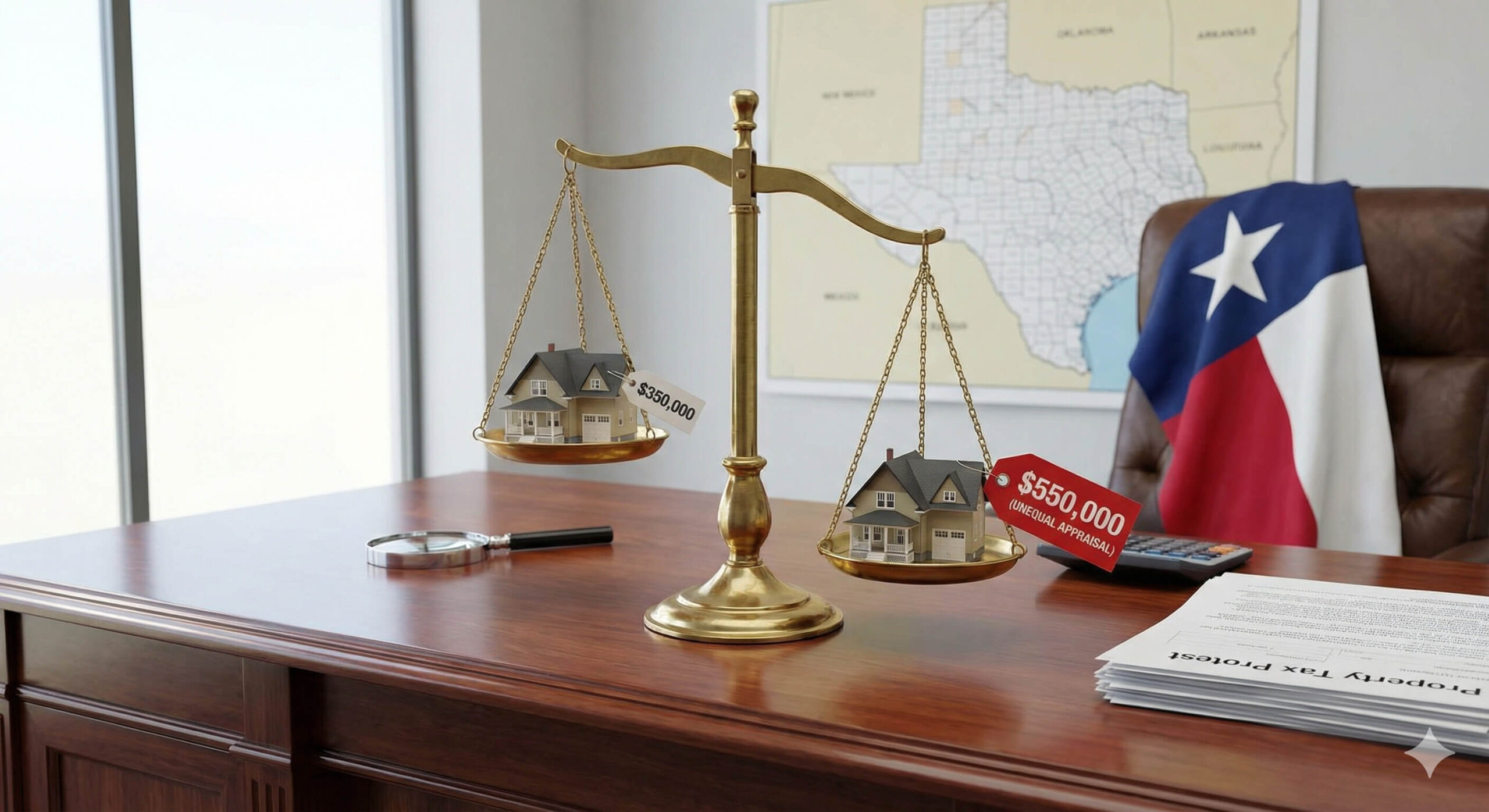
If you own property in Texas, you may have heard the term unequal appraisal but are not sure what it means or how it affects your tax bill. In simple terms, an unequal appraisal happens when your property is valued higher than similar nearby properties, which can leave you paying more than your neighbors.
The good news is that Texas property owners may have the right to challenge that result. If you are trying to understand the broader process, start with our Property Tax Appeal Texas page for an overview of how protests and appeals work.
An unequal appraisal means your property may be taxed based on a higher value than similar properties nearby, even if your appraisal district believes your assigned market value is accurate.
Texas law allows property owners to challenge a value when it is inequitably higher than comparable properties. This is one of the most important distinctions in a property tax protest because it is not exactly the same as arguing that your home or commercial property is simply worth less than the appraisal district says.
That distinction matters because a property owner may still have a strong protest even when the district insists the valuation is “market-based.” In many cases, unequal appraisal becomes the more effective argument.
Appraisal districts such as the Harris County Appraisal District value large numbers of properties every year using mass appraisal systems. Those systems are efficient, but they are not always precise.
Because of that, your property may:
Even small errors can push your value above what similar nearby properties are carrying on the tax roll. That is often the foundation of an unequal appraisal claim.
You may have grounds to protest for unequal appraisal if your property is assessed higher than similar nearby properties with the same general characteristics.
In practice, this often requires reviewing comparable properties carefully rather than just looking at your own notice in isolation. That is one reason many owners begin by reviewing how to protest property taxes and win in Texas before deciding how to build their case.
Unequal appraisal can lead directly to an unfair tax burden. Even if the district argues your property is not over market value, you may still be paying more than similarly situated owners.
That is why unequal appraisal remains one of the most important protest grounds in Texas. It gives owners another path to challenge an assessment that feels unfair and unsupported when compared with neighboring properties.
A property can be fairly close to market value and still be unequally appraised compared with similar nearby properties. That is exactly why unequal appraisal is its own protest theory.
Unequal appraisal protests are often more technical than they first appear. Success usually depends on finding the right comparable properties, organizing the evidence clearly, and presenting the argument in a way that the appraisal district or review board will take seriously.
PropertyTaxes.Law can help:
If you want help with the full protest strategy, you can also review our Property Tax Appeal Services page to see how we assist Texas property owners.
Yes. Even if you have a strong unequal appraisal argument, you still need to act before the applicable filing deadline. Waiting too long can cost you the chance to challenge the value for that tax year.
For a practical deadline overview, see Property Tax Appeal Deadlines in Texas by County.
Unequal appraisal is a common reason Texas property owners overpay. Even if your assigned market value looks reasonable at first glance, differences between your property and similar nearby properties may give you a legal basis to seek a lower appraised value.
That makes unequal appraisal an issue worth reviewing every year, especially in fast-moving markets where values shift unevenly across neighborhoods.
PropertyTaxes.Law reviews properties every year and understands where appraisal districts often make mistakes. We help property owners identify strong protest grounds, build supporting evidence, and pursue reductions through the protest process.
Let us handle the process and take the stress off your plate. Call us today at 832-919-8800 for a free, no-obligation review of your property taxes.
If your property appears to be valued higher than similar nearby properties, PropertyTaxes.Law can review your case and help you pursue a stronger protest strategy.
Get a Free ReviewBrandon and his team have proven they can perform with any product type we give them,
from industrial and office property to single and multi-family residential.
At a critical time when a property was in lease-up, we were faced with an unreasonable and unjustified assessment.
Brandon’s tenacity and responsiveness resulted in a fair assessment and the largest value change I've seen in my career.
Outstanding!! These guys are pros - they are great at what they do and great to work with.