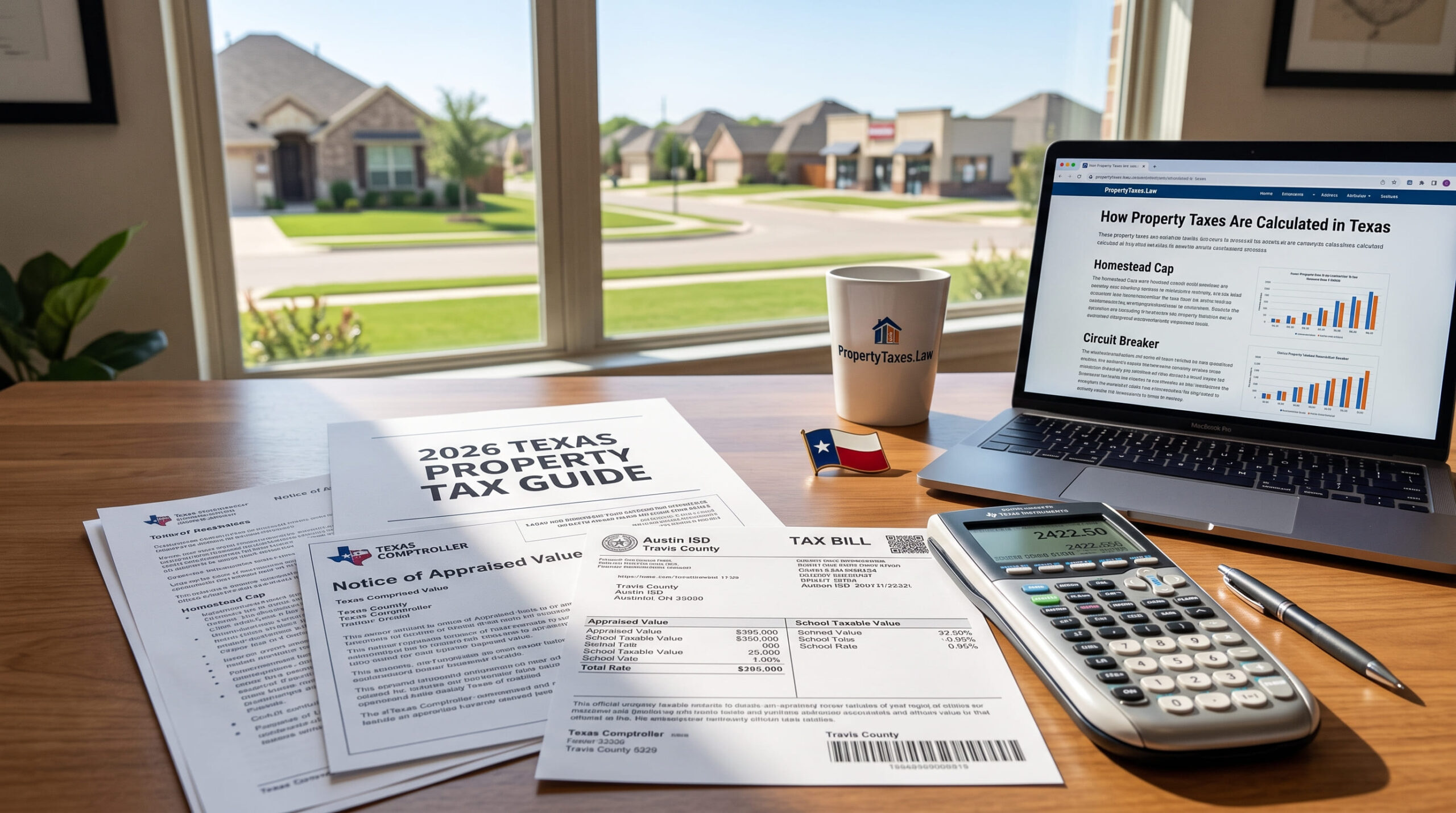
How Are Property Taxes Calculated in Texas? 6-Step Guide
Texas property taxes are calculated locally. The appraisal district determines property value, qualifying appraisal limits and exemptions affect the taxable value, and each local taxing unit applies its own adopted tax rate. Your final bill is the sum of the taxes due to the taxing units that tax your property.
For each taxing unit, the basic calculation is taxable value × that taxing unit's tax rate. Texas tax rates are often stated as dollars per $100 of taxable value, so the practical formula is (taxable value ÷ 100) × rate per $100. Because school districts, cities, counties and special districts may apply different exemptions and rates, the final property tax bill is the sum of each taxing unit's calculation.
Market Value → Appraised Value → Taxable Value × Local Tax Rate = Tax Due
Your total bill is the sum of the tax due to each taxing unit that taxes the property.
Market Value vs. Appraised Value vs. Taxable Value
Before calculating a Texas property tax bill, separate three different numbers. They are related, but they are not interchangeable.
Term
What It Means
Why It Matters
Market value
The appraisal district's estimate of what the property would sell for under the statutory market-value standard, generally as of January 1.
This is the starting valuation before an applicable appraisal limitation is considered.
Appraised value
The value used after applying an applicable appraisal limitation or special appraisal rule.
A residence-homestead cap or qualifying non-homestead circuit breaker can make appraised value lower than market value.
Taxable value
The value remaining for a particular taxing unit after applicable exemptions are deducted.
Different taxing units can have different taxable values for the same property.
How Texas Property Taxes Are Calculated: 6 Steps
1
The Appraisal District Determines Market Value
Each county appraisal district appraises taxable property. Taxable property is generally appraised at market value as of January 1. Appraisal districts can use mass-appraisal techniques and commonly recognized sales-comparison, income and cost approaches depending on the property and available data.
For a home, relevant information can include comparable sales, size, age, condition, location and property characteristics. For commercial and income-producing property, income, vacancy, expenses, capitalization assumptions, cost and depreciation may also matter.
2
Any Applicable Appraisal Limitation Is Applied
If a property qualifies for an appraisal limitation, that rule can limit appraised value even when market value rises more quickly.
For a qualifying residence homestead, the annual appraisal limitation generally caps appraised value at the lesser of market value or the prior year's appraised value plus 10% and the market value of qualifying new improvements. The limitation generally begins January 1 of the tax year after the owner first qualifies for the residence-homestead exemption.
3
Qualifying Non-Homestead Property May Receive the 20% Circuit Breaker
For 2026, certain real property that is not a residence homestead can qualify for the temporary circuit-breaker limitation if its value is $5.32 million or less and it is not in an excluded special-appraisal category.
The 2026 limitation generally restricts appraised value to the lesser of market value or the prior year's appraised value plus 20% and the market value of qualifying new improvements. The current circuit-breaker law expires December 31, 2026.
4
Exemptions Reduce Taxable Value for the Taxing Units That Grant Them
After determining the applicable appraised value, exemptions reduce the value subject to tax. The important point is that an exemption may apply differently from one taxing unit to another.
For example, in 2026 Texas school districts must provide a $140,000 general residence-homestead exemption to qualifying homeowners. Other taxing units can have different mandatory or local-option exemptions, so you should not subtract $140,000 once and assume the resulting number applies to every taxing unit.
Texas has no state property tax. Local taxing units such as school districts, cities, counties and special-purpose districts adopt their own property tax rates. A single property can therefore be subject to several separate local rates.
Do not rely on a generic statewide “average combined rate” when estimating an actual bill. Use the rates adopted by the taxing units that apply to the property and the taxable value calculated for each one.
6
The Tax Assessor Calculates and Adds the Taxes Due
For a tax rate stated per $100 of taxable value, divide the taxing unit's taxable value by 100 and multiply by that unit's adopted rate. Repeat the calculation for each taxing unit and add the results.
Texas Property Tax Formula
(Taxable Value ÷ 100) × Tax Rate per $100 = Tax Due to That Taxing UnitTax Due to Unit A + Unit B + Unit C + ... = Total Property Tax Bill
Why the old “Property Value × Tax Rate” formula was incomplete: the value actually taxed may be lower than market value because of appraisal limitations and exemptions, and the taxable value can differ among taxing units. For an accurate Texas property tax calculation, use each unit's taxable value and adopted rate.
How Does the 10% Texas Homestead Cap Affect the Calculation?
The Texas homestead cap is an appraised-value limitation, not a rule saying the final tax bill can increase by only 10%. Market value can rise by more than 10%, local tax rates can change, exemptions can change, and new improvements are treated separately.
A qualifying homeowner should therefore compare the notice's market value with its appraised value and then review the exemptions used to produce each taxing unit's taxable value.
How Does the 20% Texas Circuit Breaker Affect Commercial Property?
The temporary circuit breaker can apply to qualifying non-residence-homestead real property, including some commercial property, but it is not a universal commercial-property cap. For 2026, the property's value must be $5.32 million or less and the property cannot fall into specified excluded special-appraisal categories.
The current circuit-breaker provision expires at the end of 2026, so this section should be reviewed before publishing a 2027 version of the article.
Worked Texas Property Tax Calculation Example
Assume a qualifying Texas residence homestead has a 2026 appraised value of $400,000. For school-district taxes, the required $140,000 general residence-homestead exemption would produce a school taxable value of $260,000.
Illustrative School-District Calculation
Assume, only for this example, that the school district's adopted rate is $0.95 per $100 of taxable value.
$400,000 Appraised Value − $140,000 School Homestead Exemption = $260,000 School Taxable Value($260,000 ÷ 100) × $0.95 = $2,470 School-District Tax
You would then calculate city, county and any special-district taxes separately using the taxable value and rate applicable to each taxing unit. Adding those amounts produces the total bill.
Want to Estimate the Bill Automatically?
This article explains the formula. For the calculation tool itself, use the dedicated Texas property tax calculator.
Can Your Tax Bill Increase Even If Your Appraised Value Is Capped?
Yes. An appraisal limitation controls one part of the calculation. The final bill can also be affected by changes in exemptions, local tax rates, new improvements and which taxing units apply to the property. A 10% homestead appraisal limitation does not create a 10% cap on the final tax bill.
Who Sets Texas Property Values and Tax Rates?
Appraisal District
Determines property value, administers exemptions and maintains the appraisal records.
Local Taxing Units
School districts, cities, counties and special districts adopt their own local property tax rates.
Tax Assessor-Collector
Calculates tax bills from taxable values and adopted rates and handles tax collection for the applicable taxing units.
Important Dates in the Texas Property Tax Calculation Cycle
Timing
What Happens
January 1
General appraisal date for taxable property and an important qualification date for many property-tax rules.
Spring
Appraisal districts send required notices of appraised value. Owners review market value, appraised value, exemptions and protest rights.
May 15 / later statutory window
Normal property-tax protest deadline is generally May 15 or the applicable later 30-day notice period.
Late summer / fall
Local taxing units adopt tax rates after receiving certified appraisal information.
October 1 or soon after
Tax assessors generally mail property tax bills.
January 31
Usual payment deadline before delinquency when the bill was timely mailed.
What If the Appraisal District's Value Looks Too High?
The tax rate is only one side of the equation. If the appraisal district's value is unsupported, incorrect property data, comparable sales, unequal appraisal, condition issues, income evidence or other property-specific information may support a protest.
Each taxing unit generally applies its adopted tax rate to that unit's taxable value. When a rate is expressed per $100, the formula is taxable value divided by 100, multiplied by the rate. The taxes due to all applicable taxing units are then added together.
What is the Texas property tax formula?
For each taxing unit, use: (taxable value ÷ 100) × tax rate per $100 = tax due. The total bill is the sum of the tax due to each school district, city, county and special district that taxes the property.
Is Texas property tax based on market value or taxable value?
The appraisal district starts with market value, but appraisal limitations can affect appraised value and exemptions can reduce that amount to taxable value. The actual tax calculation is based on the taxable value applicable to each taxing unit.
Does the Texas homestead cap limit my tax bill to a 10% increase?
No. The 10% rule is an appraisal limitation on qualifying residence-homestead appraised value. It is not a 10% cap on the final property tax bill, which can also be affected by tax rates, exemptions and new improvements.
What is the 2026 Texas non-homestead circuit breaker?
For 2026, certain qualifying real property that is not a residence homestead and is valued at $5.32 million or less may receive a 20% appraisal limitation, subject to statutory exclusions. The current provision expires December 31, 2026.
How much is the Texas homestead exemption in 2026?
For 2026, school districts must provide a $140,000 general residence-homestead exemption to qualifying homeowners. Other taxing units can have different mandatory or local-option exemptions.
Who sets property tax rates in Texas?
Texas does not have a state property tax. Local school districts, cities, counties and special-purpose districts adopt property tax rates. The appraisal district determines property value but does not set those local tax rates.
Where can I calculate my Texas property tax estimate?
Use PropertyTaxes.Law's dedicated Texas property tax calculator for an estimate, then confirm the actual taxable values, exemptions and tax rates with the local appraisal district and tax office.
Think the Value Used in Your Property Tax Calculation Is Too High?
PropertyTaxes.Law can review the appraisal, identify valuation or exemption issues, organize evidence and evaluate whether a property tax protest could reduce the taxable value used in your bill.
This article provides general educational information and is not legal, tax or appraisal advice. Property values, appraisal limitations, exemptions, tax rates and deadlines depend on the property, taxing units and current law. Confirm current values, exemptions and rates with the applicable appraisal district and tax office.
Brandon and his team have proven they can perform with any product type we give them,
from industrial and office property to single and multi-family residential.
- HunterBrown, InSite Realty Partners, L.P.
At a critical time when a property was in lease-up, we were faced with an unreasonable and unjustified assessment.
Brandon’s tenacity and responsiveness resulted in a fair assessment and the largest value change I've seen in my career.
- Jeremy Bartholomew
Outstanding!! These guys are pros - they are great at what they do and great to work with.
- David Denenburg, Denenburg Interests, LLC / Station 3