

A district court petition can challenge an unfavorable appraisal review board (ARB) order. Here is how to weigh its filing deadline, tax-payment rule, costs and evidence process against other Texas appeal routes.
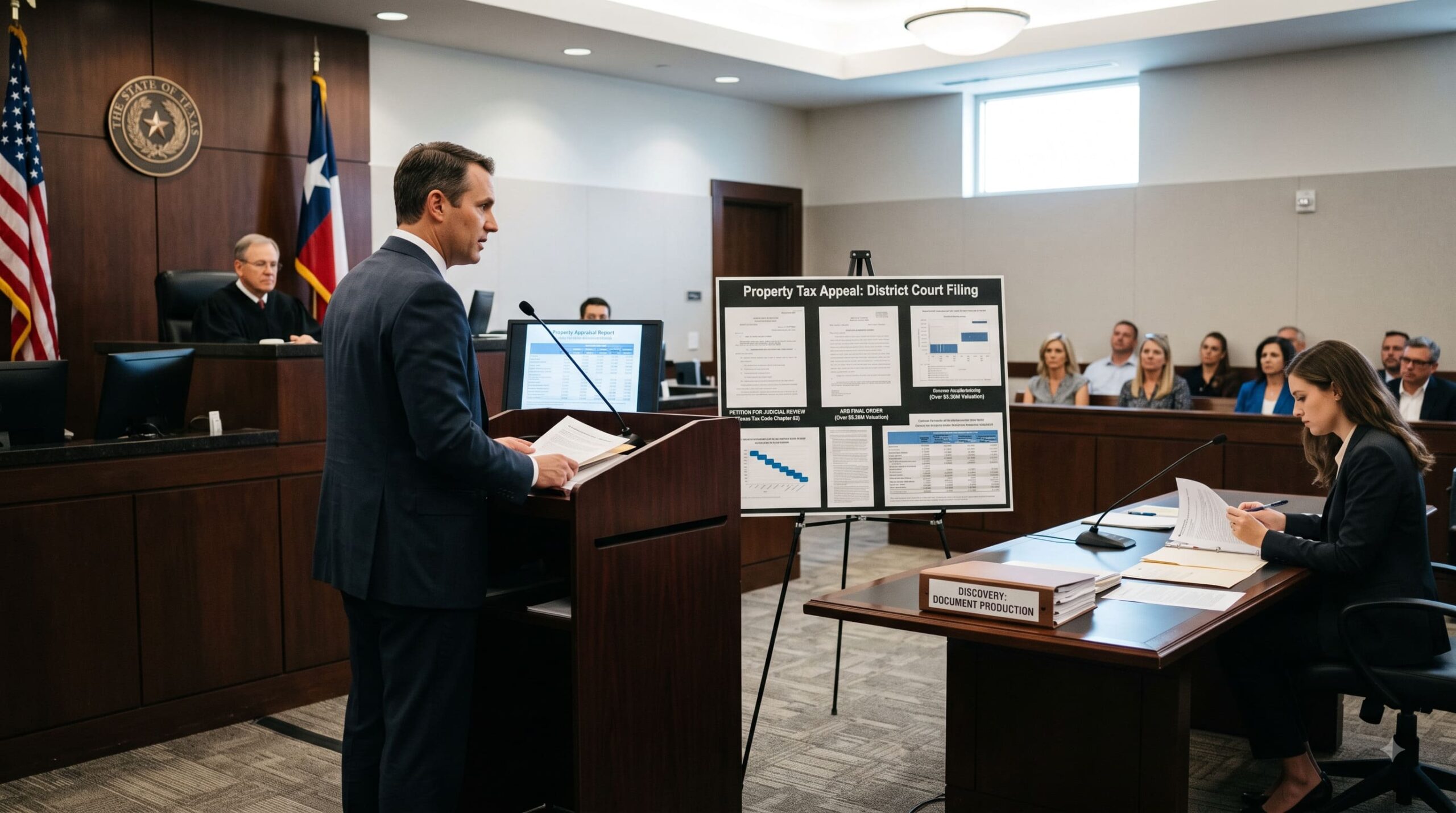
There is no reliable statewide flat price or fixed duration. Budget for the applicable district clerk's filing fee, citation and service charges, attorney fees under your agreement, and any evidence or expert costs. A lawsuit can settle after filing or continue through discovery and trial, so timing depends on the court and case. You generally must file the petition for review within 60 days of receiving the ARB's written order and meet the tax-payment requirements while the case is pending.
Keep two deadlines separate: The petition deadline runs from receipt of the written ARB order. The Tax Code §42.08 payment requirement is tied to the property-tax delinquency date. Filing a lawsuit does not automatically postpone the required payment.
| Cost | What to verify |
|---|---|
| Court filing and citation | Ask the district clerk for the current fee schedule for a new petition and any citations or copies. The actual amount depends on the county and filing details. |
| Service | Confirm who must be served and the sheriff, constable or private process server's charge. |
| Attorney fees | Review the engagement agreement for hourly, flat, contingency or mixed fees, expense reimbursement, and what happens if the case settles or goes to trial. |
| Evidence and experts | Ask whether an appraisal, specialist analysis, deposition transcript or other discovery expense may be needed and who pays it. |
| Tax payment | Separately calculate the amount required under §42.08 before delinquency; this is a tax obligation, not a court filing fee. |
Example: total case spending equals local filing and service charges + agreed legal fees + any expert or discovery expenses. Request a case-specific written estimate. The Texas judiciary explains that filing fees vary with county decisions and case type.
Confirm receipt date, property, tax year and issues decided. Evaluate whether district court is the appropriate route.
File with the district court in the property's county generally within 60 days after receiving the written order, then complete required service.
Determine the §42.08 amount and pay it before the delinquency date, or timely pursue any applicable statutory relief through the court.
Exchange relevant evidence, evaluate settlement, and prepare for a court resolution if no agreement is reached.
Some cases settle earlier; others require more discovery or a trial date. Ask about court scheduling and likely evidence needs before estimating the time and cost of a specific case.
A Chapter 42 appeal does not stop the delinquency date. Section 42.08 requires a timely payment to preserve the right to a final determination. The amount is determined under the statute using the disputed and undisputed taxes, the appealed order, and the preceding year's taxes. An owner electing the undisputed-tax amount must include the required written statement with the appeal. Have the tax office and your attorney confirm the calculation for the property.
If paying the required amount would unreasonably restrain access to court, the statute provides an oath-of-inability procedure for the court to decide. Do not assume filing an oath by itself excuses payment; obtain advice on the procedure and deadlines. See the Texas Comptroller's appeals guidance.
| Factor | District court | Regular binding arbitration | SOAH |
|---|---|---|---|
| Filing | Petition generally within 60 days of receiving written ARB order | Request and deposit within 60 days of receiving ARB order | Notice to chief appraiser within 30 days; $1,500 deposit within 90 days |
| Eligibility | Appealable ARB order; no general property-value cap | Value or unequal appraisal; homestead has no cap, other property ARB value ≤ $5 million | Value or unequal appraisal; ARB value > $1 million; industrial property excluded |
| Process | Court litigation, with discovery and possible settlement or trial | Comptroller-administered process and binding arbitrator decision | Administrative law judge hearing with a deposit and potential additional costs |
| Tax payment | Section 42.08 payment requirement before delinquency, subject to statutory relief | Timely tax-payment eligibility requirements also apply | Confirm applicable payment requirements when filing |
For details on other routes, see our ARB appeal-options guide and binding arbitration guide. A court case may be appropriate even when arbitration is available; the facts, issue and anticipated evidence determine which path merits review.
Some appealable ARB determinations are not within RBA's or SOAH's narrower value and unequal-appraisal scope.
Formal discovery may matter when documents, testimony or expert analysis are central to the disputed valuation.
Non-homestead property with ARB value over $5 million does not qualify for RBA. Eligible nonindustrial value disputes over $1 million may also have a SOAH option.
For commercial valuation issues, review the commercial protest guide. No reduction or fee outcome is guaranteed; assess likely tax savings against the cost and evidence needed for the particular case.
There is no statewide all-in price. Confirm the district clerk's current filing and citation fees, service charges, attorney fees and any evidence costs for the county and case.
It varies. Settlement can resolve a case before trial, while discovery, experts and court scheduling can extend it. Ask counsel for a case-specific range rather than relying on a fixed statewide estimate.
A district court petition for review generally must be filed within 60 days after receiving the ARB's written order. Calendar the receipt date and verify the applicable procedure promptly.
Yes. Section 42.08 requires a timely payment calculated under the statute before delinquency to preserve the appeal, unless the court grants applicable relief through the statutory procedure.
No. Non-homestead property above the $5 million RBA cap may qualify for SOAH if the ARB value is over $1 million, the issue is value or unequal appraisal, and the property is not industrial. Check the shorter SOAH notice deadline.
Representation rules depend on who owns the property and the court proceeding. The Comptroller recommends consulting an attorney before filing; an owner should obtain case-specific advice on procedure, payment and evidence.
Reviewed October 10, 2026. Confirm current court fees and filing instructions with the relevant district clerk.
PropertyTaxes.Law can review the order, potential routes, expected costs and evidence for your specific property.
Request an Appeal ReviewBrandon and his team have proven they can perform with any product type we give them,
from industrial and office property to single and multi-family residential.
At a critical time when a property was in lease-up, we were faced with an unreasonable and unjustified assessment.
Brandon’s tenacity and responsiveness resulted in a fair assessment and the largest value change I've seen in my career.
Outstanding!! These guys are pros - they are great at what they do and great to work with.